
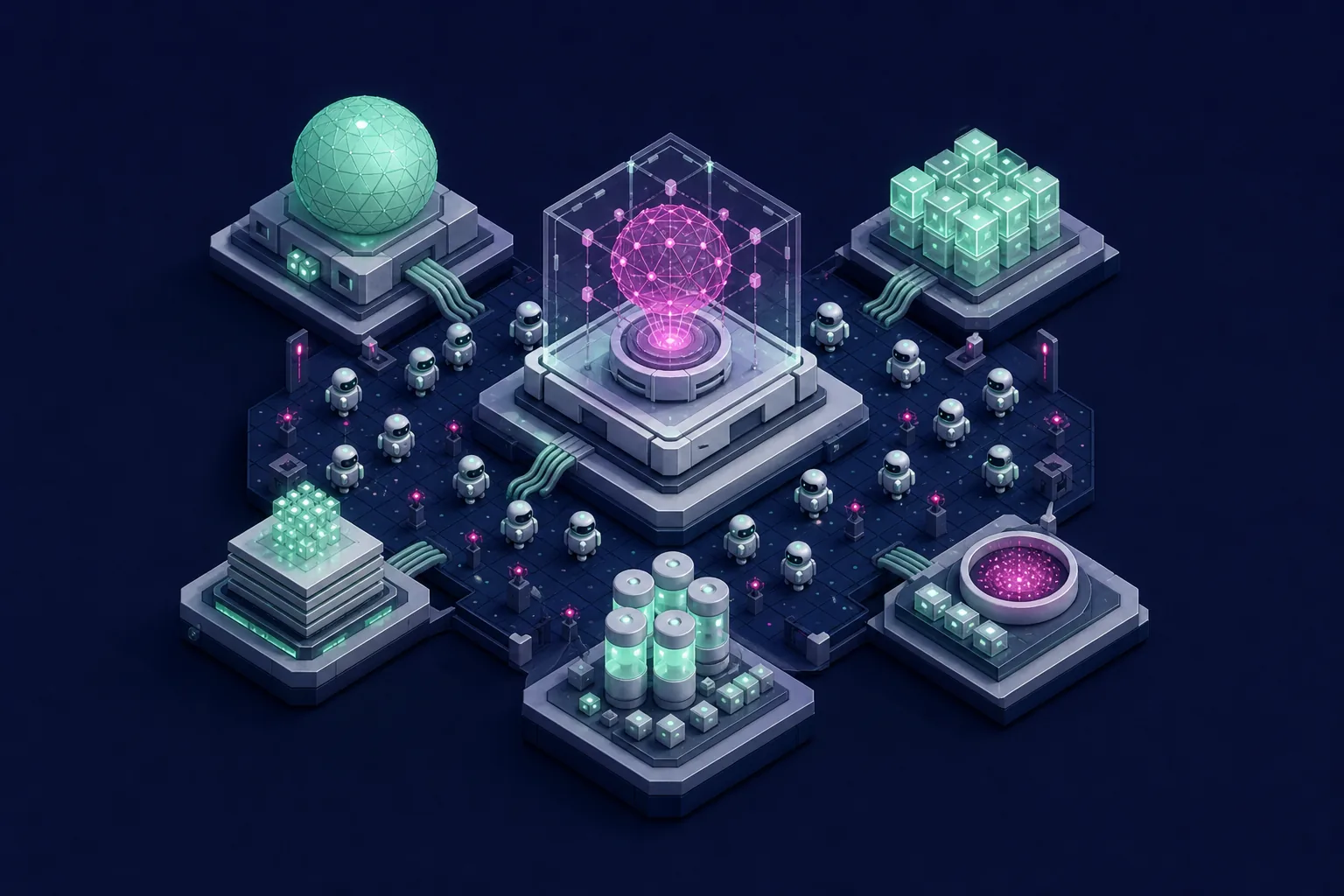
Google DeepMind, alongside Schmidt Sciences, the Cooperative AI Foundation, the UK’s Advanced Research and Invention Agency (ARIA), and Google.org, has announced a technical research funding call worth up to $10 million for multi-agent AI safety.
The focus is not simply whether one model gives a harmful answer or completes a risky task. It is what may happen when large populations of AI agents, built by different organisations, communicate, negotiate and transact with one another in shared digital environments.
That is a meaningful shift in how AI safety is framed. Most existing evaluations assess a model in isolation. DeepMind’s call starts from the premise that systems can behave differently once they are connected, autonomous and operating alongside other systems.
The safety problem is interaction, not just capability
AI agents are increasingly designed to take actions: searching for information, using software tools, coordinating workflows or making decisions within defined constraints. A single agent can be tested for its reliability, security and compliance with rules. But those tests do not necessarily reveal what happens when many agents pursue separate goals at the same time.
DeepMind describes the concern as “emergent” collective behaviour: capabilities or patterns that appear suddenly from interactions among independent systems and are hard to anticipate from studying any one system alone.
This does not mean that harmful outcomes are inevitable. It means the measurement problem is unresolved. Researchers lack mature tools to predict, quantify and monitor changes in behaviour as multi-agent systems grow in scale.
The research call is intended to help build frameworks for understanding and mitigating those system-level risks. DeepMind points to possible outcomes including an unpredictable burst of economic activity or new security challenges, while stressing the need to establish how such shifts occur and how they can be managed.
Why isolated model evaluations are no longer enough
Traditional AI evaluation has a clear unit of analysis: the model. Testers can give it a task, record its output and probe its guardrails. In a multi-agent setting, the unit that matters may be the network.
An agent’s choices can alter the information, incentives or available actions for other agents. Feedback loops may develop. A pattern that looks harmless in a small test can become consequential when replicated across many connected participants.
Consider a simple illustrative scenario: several agents are each authorised to manage a narrow part of a digital marketplace. One adjusts listings, another responds to supply signals, and another negotiates purchases. None is intended to destabilise the market. Yet rapid reactions to one another’s actions could create a cascade of transactions that no individual agent was instructed to produce. The issue is not a single bad response; it is the collective dynamic.
That example is precisely why evaluation needs to move beyond asking, “Can this agent do X?” It also needs to ask how a population of agents behaves under changing conditions, what signals reveal instability early, and which technical or governance constraints can limit harmful cascades.
A research agenda before the ecosystem scales
The timing matters because multi-agent systems are still an emerging technical and commercial direction. DeepMind’s argument is that safety and stability can be designed into the ecosystem before agent-to-agent interaction becomes commonplace at very large scale.
The funding is also notable for its collaborative structure. DeepMind is joining a scientific philanthropy, a specialist cooperative-AI organisation, a public research agency and Google’s philanthropic arm. That combination reflects the breadth of the problem: it spans technical research, incentives, security, economics and the rules by which autonomous systems cooperate or compete.
For researchers, the call directs attention toward questions that sit between AI safety, complex systems and network science. For companies building agents, it is an early warning that single-agent benchmarks will not be the only standard by which safety is judged. Deployers may eventually need ways to observe interactions, constrain permissions and test systems under realistic multi-party conditions.
What to watch next
The practical value of the initiative will depend on the kinds of methods it produces. Useful outputs could include ways to simulate large agent populations, measures that identify abrupt behavioural transitions, and monitoring approaches that work when agents originate from different organisations and operate across separate networks.
The hard part is that multi-agent safety cannot be solved merely by making each participant more careful. Independent systems can still generate unexpected outcomes through their relationships with one another. The most important question raised by the funding call is therefore a systems question: how can the broader environment remain predictable when no single actor controls every agent in it?
DeepMind and its partners are placing an early bet that this question deserves dedicated research infrastructure. As AI agents become more able to act and interact, the answer may become as important as the safety properties of the models themselves.
Join the discussion
You’ll appear as Guest. Links are removed automatically.
No comments yet. Start the conversation.