
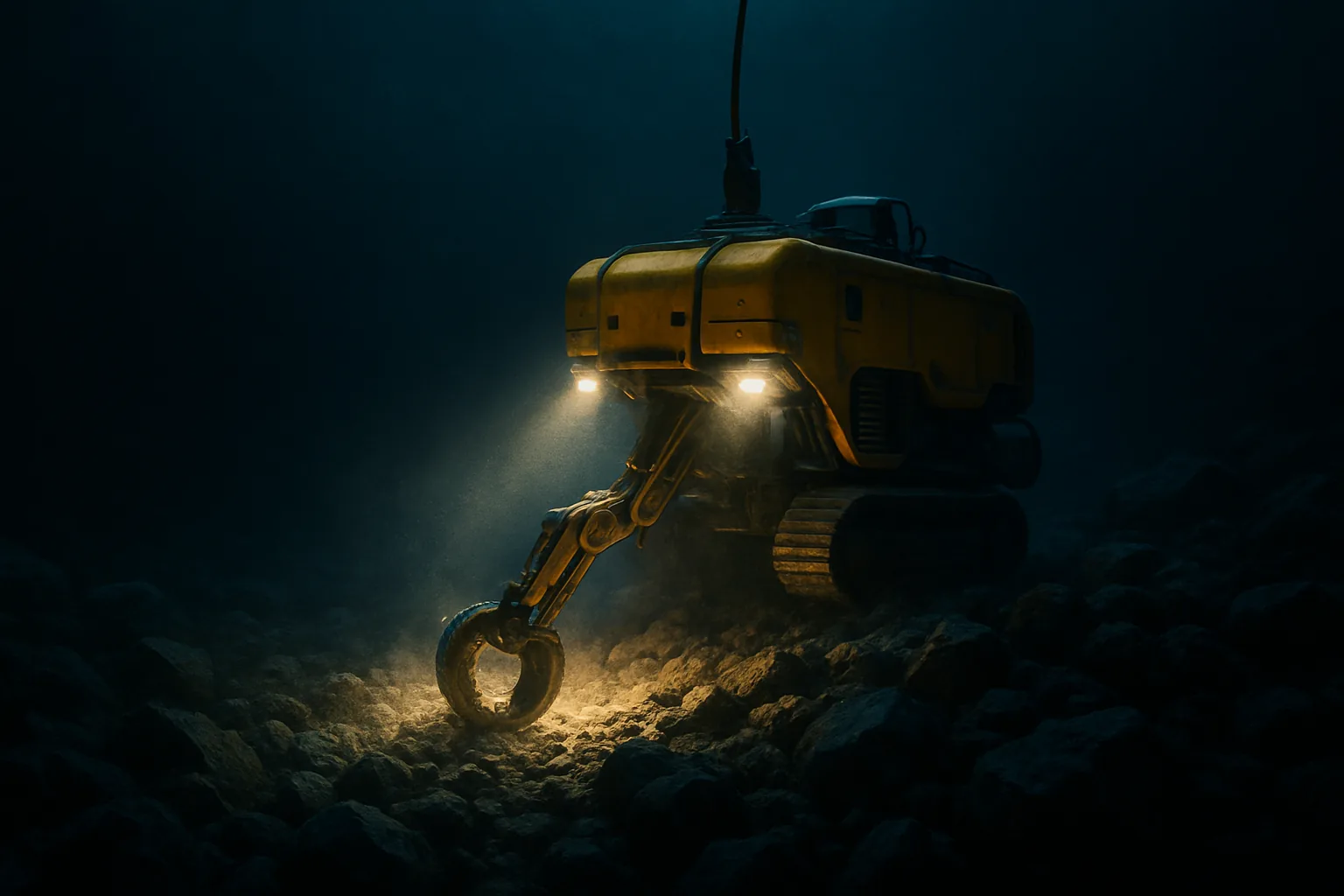
Deep-ocean mining matters because it sits at the collision point between resource demand and environmental uncertainty. As countries and companies search for minerals needed in batteries, electronics, and clean-energy systems, the deep sea appears increasingly attractive as an extractive frontier. But unlike many terrestrial landscapes, large parts of the deep ocean remain poorly understood ecologically. That makes the decision to mine there more than a technical question about feasibility. It becomes a moral and political question about how much uncertainty society is willing to accept when the environment in question is both fragile and largely unseen.
That is why the issue matters beyond niche science or resource policy. It reflects the broader pattern by which industrial systems push outward faster than governance and ecological knowledge can comfortably follow.
Why the demand story is so compelling
The pressure behind deep-sea mining is not imaginary. Many governments and firms worry about supply chains for minerals associated with electrification, storage, and advanced technology. That creates a powerful narrative in favor of opening new sources, especially when land-based mining carries its own social and environmental costs. The deep sea can therefore be framed as necessary rather than optional.
This is why the debate matters. It is not a simple clash between growth and nature, but a harder conflict between competing models of extraction risk.
A useful way to frame it is this: deep-sea mining asks whether a transition sold as cleaner should be allowed to externalize uncertainty into the least understood ecosystems on Earth.
Why scientific caution is unusually important
Unlike better-studied environments, the deep ocean still contains vast unknowns about biodiversity, recovery times, and ecological interdependence. Disturbance in such systems could produce consequences that are hard to predict and harder still to reverse. That makes the standard logic of “learn by doing” especially risky here, because the doing itself may erase some of what science has not yet had time to understand.
This is one reason the issue matters. It turns ignorance into a central policy variable rather than a temporary inconvenience.
Why governance may lag the frontier
Resource frontiers often move faster than the institutions meant to regulate them. Commercial interest, geopolitical competition, and technological optimism can create momentum before a durable governance regime exists. Deep-sea mining appears especially vulnerable to that pattern because the economic incentives are rising while the environmental baseline remains incomplete.
That is why the debate matters beyond the ocean. It is a case study in whether modern governance can restrain extraction until knowledge catches up, rather than treating uncertainty as an acceptable cost of speed.
In frontier industries, the first rule written often says as much about political appetite as about ecological wisdom.
What matters next
The key questions are whether international rules become more precautionary, whether scientific assessment gains enough authority to slow exploitation, and whether alternative supply strategies reduce the pressure to mine at all. Those choices will shape whether the deep ocean becomes another industrial zone or a boundary that remains largely intact.
That is why deep-ocean mining matters. It tests whether humanity can confront material scarcity without automatically treating every unexplored ecosystem as the next justified sacrifice.
The real challenge is not only whether we can mine the deep sea. It is whether we should be willing to make that answer easier before we understand what could be lost.