
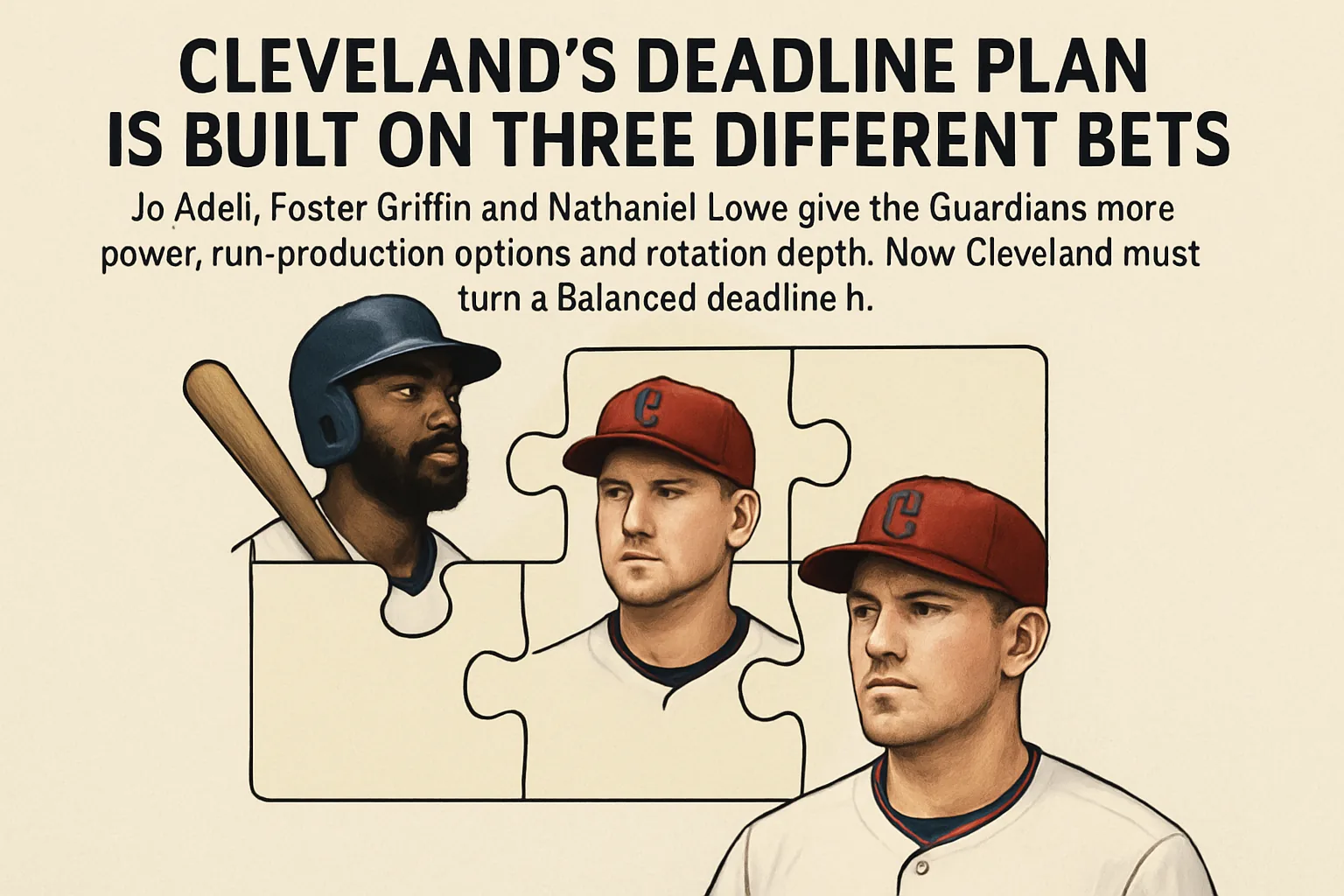
The Cleveland Guardians did not use the 2026 trade deadline to chase one sweeping solution. They added three players with distinct jobs: outfielder Jo Adell to supply power and defensive flexibility, first baseman Nathaniel Lowe to strengthen the lineup from the left side, and All-Star starter Foster Griffin to deepen the rotation.
Each addition addresses a recognizable need. The larger question is whether three targeted upgrades can produce enough incremental improvement to change Cleveland’s position in the American League playoff race.
Three additions aimed at three pressure points
Adell arrives from the Los Angeles Angels after hitting 16 home runs and driving in 62 runs this season. Those numbers are below the career-best 37 homers and 98 RBIs he recorded in 2025, but they still give Cleveland another credible power threat. The Guardians sent minor league catcher Jacob Cozart to the Angels in the deal.
For Cleveland, Adell’s value is not limited to his home-run total. His outfield versatility creates more lineup combinations, while his ability to change a game with one swing gives the offense an element that becomes especially useful when hits are difficult to string together.
Lowe offers a different profile. The 31-year-old first baseman was batting .266 with 12 home runs and 37 RBIs for Cincinnati before the trade. His bounce-back season gives Cleveland another source of run production and a left-handed bat capable of adding balance around the club’s existing hitters.
Then there is Griffin, the most accomplished performer of the three this season. The 31-year-old left-hander went 12-3 with a 3.06 ERA for Washington after returning to the major leagues following three seasons in Japan. He gives Cleveland a productive starter immediately, but he also provides insurance against injury, fatigue or a late-season decline elsewhere in the rotation.
A portfolio approach to the deadline
The Guardians’ strategy contrasts with the headline-grabbing deals elsewhere in baseball. Boston acquired three-time All-Star catcher Adley Rutschman, while Philadelphia added three-time batting champion Luis Arraez. Those transactions place a large share of the deadline’s expectations on one prominent player.
Cleveland spread its bet across the roster. Adell can raise the lineup’s power ceiling. Lowe can improve its ability to create and convert scoring opportunities. Griffin can prevent the pitching staff from becoming overly dependent on the same group of starters through the final weeks.
That distribution matters because contenders rarely reach August with only one weakness. A single star may transform a lineup spot, but he cannot cover innings in the rotation or provide a second useful matchup off the bench. Cleveland’s package is designed to produce smaller improvements in several places rather than a dramatic change in one.
Consider a close game in which the Guardians have generated traffic on the bases but need an extra-base hit. Lowe can give the lineup another left-handed run producer, while Adell supplies a separate power option and allows the manager to adjust the outfield without removing that threat entirely. On another night, Griffin’s six competitive innings could be the contribution that keeps the bullpen fresh for the rest of a series. No single moment defines the deadline, but those are the situations Cleveland is trying to improve.
Why the moves carry real risk
The case for the newcomers is easy to see. The certainty is not.
Adell’s 2025 power establishes what his best offensive outcome can look like, but his lower home-run total this year also makes immediate expectations worth controlling. Cleveland needs useful production in 2026, not merely a repeat of an earlier peak.
Lowe’s season has been described as a rebound, which means the Guardians are betting that the improvement will hold through a change of team and league. Griffin must make a similar transition after succeeding in Washington. His record and ERA are strong, yet results accumulated before a trade do not automatically transfer to a new defense, catcher and schedule.
There is also an integration problem common to multi-player deadlines. More options create better matchups, but they also require decisions about playing time, batting order placement and rotation scheduling. Cleveland has to learn quickly which combinations work. August offers little room for a long adjustment period.
Chicago begins the evaluation, not the verdict
The Guardians’ first road series in Chicago after the deadline provides an immediate test, although a few games cannot settle whether the trades succeeded. The more useful early signals will be how consistently Adell and Lowe create dangerous plate appearances, whether the offense produces runs without leaning on one hitter, and whether Griffin gives the rotation dependable innings.
The standings will eventually provide the only verdict that matters. Cleveland made these deals because it believed the current roster was close enough to justify reinforcement. The front office has now supplied more power, another run-producing bat and an accomplished starter. The responsibility shifts to the field.
That makes this deadline less about winning the transaction headlines and more about accumulating additional ways to win games. If Adell, Lowe and Griffin each solve even part of the problem they were acquired to address, Cleveland’s balanced approach could have more value than any one move suggests on its own.