
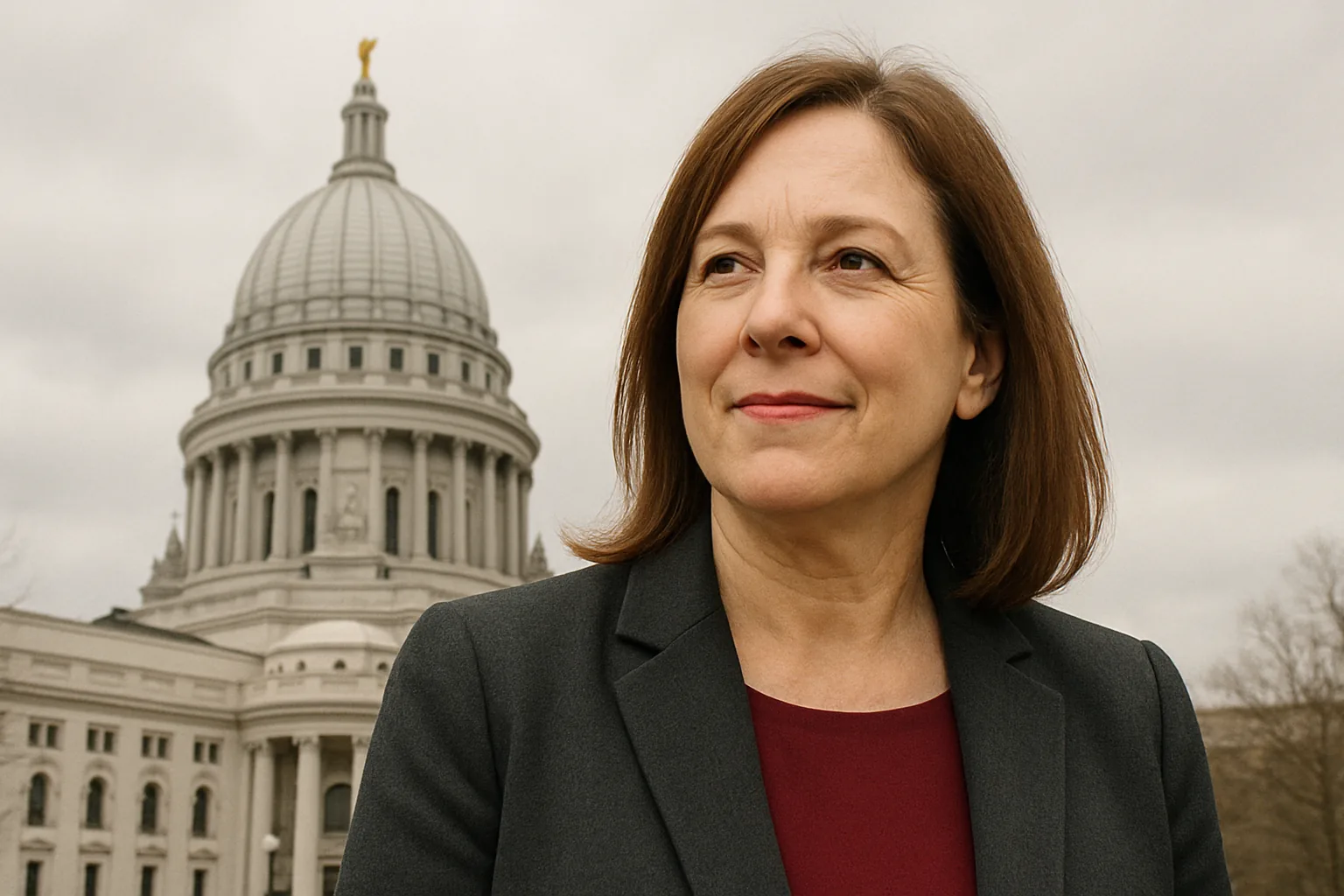
Wisconsin voters on April 7 elected Appeals Court Judge Chris Taylor to a 10-year term on the state Supreme Court, defeating conservative Judge Maria Lazar and expanding the court’s liberal majority from 4-3 to 5-2.
That is the headline. The more important point is what comes next: this was not a routine judicial swap. Taylor’s win strengthens one side of the court before a period when major cases involving congressional redistricting, abortion restrictions, and union and labor disputes could reach the justices. In a state where statewide politics is regularly close, the composition of the court can shape policy almost as much as the governor or legislature.
Why this race matters beyond one seat
Taylor is replacing outgoing Justice Rebecca Bradley. The result does more than preserve liberal control of the court. It makes that control more durable and less fragile.
A 4-3 majority can govern, but it is narrow. A 5-2 majority gives the dominant bloc more room to absorb disagreement, recusals, or case-by-case variation without immediately putting the outcome of every major dispute in doubt. That matters in a court expected to hear politically charged cases.
The source material points to three especially important areas: congressional redistricting challenges, abortion restrictions, and labor fights. Each of those reaches well beyond legal specialists.
Redistricting cases can influence how political power is distributed for years. Abortion cases can determine the practical reach of state restrictions. Labor and union disputes can affect public-sector rules, organizing, and employer-worker power in a state with a long history of conflict over those questions.
The court is becoming a bigger political arena
State supreme court elections have increasingly become proxy fights over issues that legislatures either cannot settle cleanly or have already deadlocked on. Wisconsin fits that pattern.
The court’s new 5-2 liberal majority means activists, party strategists, unions, business groups, and abortion-rights advocates will all view the court as a more decisive venue. That does not predetermine how every case will be decided. It does mean the ideological balance is no longer a footnote. It is one of the main facts shaping expectations.
This is why the result carries weight heading into the 2026 midterms. Wisconsin is already one of the states both parties watch closely for control of Congress and for signals about voter mood. When the state’s top court is positioned to hear disputes tied to maps, election rules, and politically loaded social policy, a judicial race stops looking secondary.
A concrete example of what changes
Take congressional redistricting. If a challenge to Wisconsin’s congressional maps reaches the court, the stakes will not be abstract. A ruling on how districts are drawn can alter which voters are grouped together, which seats become more competitive, and how hard it is for either party to hold or win House seats.
That does not mean Taylor’s election automatically decides any future maps case. Courts are still constrained by the claims before them and the legal arguments presented. But compared with a 4-3 bench, a 5-2 court changes the political reading of any maps challenge from the start. Parties will calculate differently. Advocates will decide differently whether a lawsuit is worth bringing. National operatives will pay closer attention because the downstream effect could reach beyond Madison.
What Taylor’s background adds to the picture
The source notes that Taylor is a former Democratic state lawmaker and former policy director for Planned Parenthood, in addition to serving as an appeals court judge. Those facts help explain why this race drew such clear ideological framing.
Her critics and supporters are likely to interpret her arrival on the court through that record, especially on abortion-related questions. At the same time, her election underscores something broader about modern state court politics: candidates for supposedly less partisan institutions are increasingly understood through the same coalition lenses voters use in executive and legislative races.
That does not erase the court’s judicial role. It does show why these contests now attract so much attention. Voters are not only choosing legal résumés. They are choosing the likely center of gravity of the court.
What to watch next
The practical meaning of Taylor’s win depends on the docket. The source already points to the issues most likely to matter, and they are enough to make this a consequential election even before specific rulings arrive.
- Congressional redistricting: Any challenge here will be watched nationally because Wisconsin is politically competitive and House control can turn on a small number of districts.
- Abortion restrictions: The court’s balance matters because state-level abortion law remains one of the most contested questions in the country.
- Union and labor disputes: These cases may get less national attention than abortion or election law, but they can have direct effects on workers, employers, and state policy.
The other thing to watch is tone. A 5-2 court may reduce the sense that every high-profile case is one vote away from flipping. That could make the court look more stable in one sense and more politically consequential in another. Stability in the majority often encourages litigants to test larger questions.
For Wisconsin, that is the real significance of this election. Chris Taylor’s victory was not just a win in a judicial contest. It widened the operating room for the court’s liberal bloc at a moment when some of the state’s biggest unresolved fights are moving toward the judiciary.
In a battleground state, that is not background noise. It is part of the main story of how power will be exercised over the next several years.