
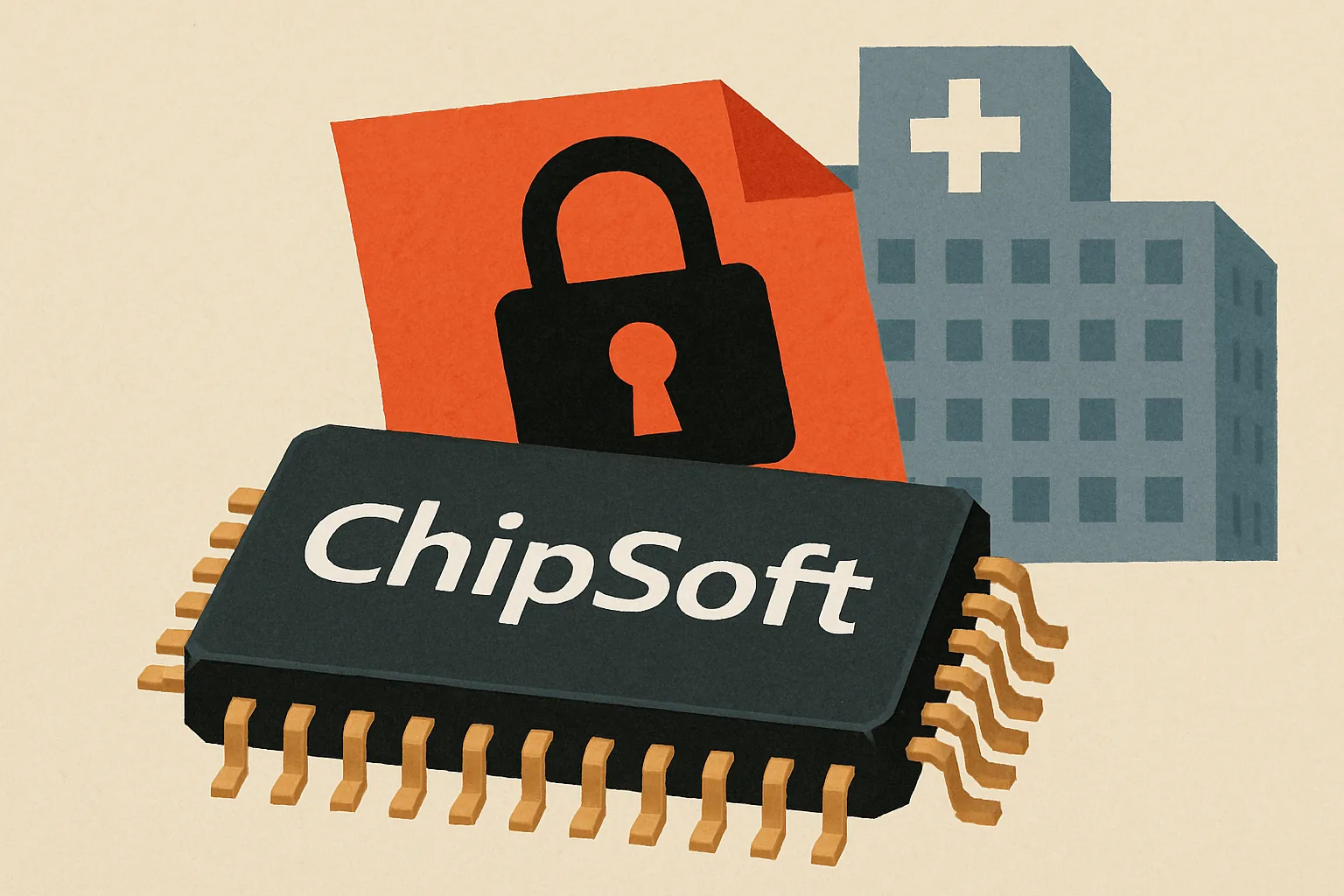
ChipSoft, one of the most important healthcare software providers in the Netherlands, is restoring services after a ransomware attack that disrupted digital tools used by hospitals, patients, and care providers.
The attack matters not just because ChipSoft was hit, but because of where the company sits in the healthcare stack. Its systems are deeply embedded in hospital operations, and its flagship HiX platform is used widely across Dutch healthcare. When a vendor at that level has to disable services and warn customers to disconnect, the incident stops being a company problem and becomes a sector problem.
What happened
According to the source material, ChipSoft was affected by a cyberattack between April 8 and April 10, 2026. The company reportedly warned healthcare institutions about possible unauthorized access and advised them to disconnect from its systems while cleanup work was underway.
The Netherlands' healthcare CERT, Z-CERT, later confirmed the incident involved ransomware. It said it was working with ChipSoft and healthcare institutions to determine impact and support recovery. As a precaution, ChipSoft disabled connections to services including Zorgportaal, HiX Mobile, and Zorgplatform. Its website and digital services for patients and healthcare providers were also taken offline.
Several hospitals then took patient portals offline as a protective step. The source material indicates core care operations continued, which is an important distinction. This was not presented as a nationwide clinical shutdown. But it was still a significant interruption to digital access and communications around care.
Why this is bigger than one vendor outage
Healthcare ransomware stories often get framed around a single breach event: attackers get in, systems go down, recovery begins. That misses the harder part of incidents like this. A supplier such as ChipSoft is not just another software company with hospital customers. It is part of the operational infrastructure those hospitals depend on every day.
That creates a multiplier effect. Even if the ransomware only directly compromises one company, hospitals have to make fast risk decisions about connected systems, patient access, remote workflows, and trust in data exchange. In this case, the advice to disconnect systems was prudent. It was also disruptive by definition.
The source material describes ChipSoft as a major Electronic Health Record provider and notes reporting that its secure data facilities are used by roughly 70% of Dutch hospitals. Even without claiming full technical dependency across all clinical functions, that level of market presence explains why a single vendor incident can ripple across multiple institutions in a matter of hours.
What the disruption probably looked like on the ground
A useful way to understand the impact is to separate clinical continuity from digital convenience and coordination.
Hospitals can continue delivering care while patient portals, mobile access, or external digital channels are restricted. Staff can switch to downtime procedures, delay nonessential digital interactions, or temporarily move certain communications offline. That is very different from saying nothing happened. It means hospitals absorbed the shock by narrowing the attack surface and sacrificing convenience, speed, and some workflow efficiency.
Consider a simple example. A patient scheduled for follow-up lab work may normally use a portal or mobile app to review information, message a care team, or manage appointments. If that system is taken offline as a precaution, the appointment may still happen, but the surrounding experience worsens immediately: fewer self-service options, more phone traffic, less visibility, and more manual work for staff. Multiply that across several hospitals and the operational cost becomes obvious, even if emergency rooms and inpatient care stay open.
That is the part of healthcare cyber incidents that readers often underestimate. The first visible symptom is not always canceled care. Sometimes it is the rapid disappearance of the digital layer that has quietly become part of ordinary care delivery.
The third-party risk lesson is hard to ignore
The clearest editorial takeaway from this incident is not simply that healthcare remains a ransomware target. That is already well established. The sharper lesson is that healthcare organizations are still only as resilient as the vendors they are tied to.
Third-party risk in healthcare is unusually difficult to manage because the sector depends on a dense mix of EHR vendors, patient communication platforms, hosting providers, imaging systems, remote access tools, and specialist integrations. Each connection can save time and improve care coordination. Each connection also creates another path through which a single compromise can force defensive action across multiple organizations.
What stands out in the ChipSoft case is the precautionary response. Z-CERT advised healthcare organizations to disconnect systems. Hospitals took portals offline. ChipSoft shut down specific digital services and began phased restoration while its investigation into the scope and cause continued. Those are sensible measures, but they also show how limited the choices become once a trusted supplier is in incident mode. Customers are no longer deciding how to optimize service. They are deciding how much connectivity they can afford to lose.
What hospitals and operators should watch next
ChipSoft has said its investigation is ongoing, so some of the most important facts are still unresolved. That includes the full scope of the compromise, the initial access path, and whether any customer or patient data was affected. Until those details are established, the most responsible reading is a narrow one: a confirmed ransomware incident caused service disruption and precautionary disconnections across an important part of Dutch healthcare IT.
What comes next will matter as much as the initial event. Healthcare organizations using ChipSoft systems will want clarity on restoration sequencing, forensic findings, validation steps for reconnecting systems, and any changes required in their own environments. Sector-wide observers will also be watching whether this leads to tighter vendor isolation practices, stronger contingency planning for portal and app outages, or new expectations around incident communication from critical healthcare suppliers.
There is also a reputational question here that goes beyond one recovery timeline. In healthcare, trust is not only about data confidentiality. It is also about predictability. Patients expect access to records and communication channels. Hospitals expect core vendors to be available, especially when those vendors sit close to electronic records and patient-facing services. A ransomware incident chips away at that confidence even when core care continues.
What this incident really tells us
The ChipSoft attack is a reminder that healthcare resilience cannot be measured only by whether hospitals stay open. That is too low a bar. A modern healthcare system also depends on the stability of the software and service providers around it, especially the ones that handle records, patient access, and secure data exchange at scale.
In that sense, this was not a narrow vendor outage. It was a live test of how a healthcare network responds when a major shared supplier becomes a potential entry point for risk. The immediate answer appears to be: disconnect fast, keep care running where possible, and restore slowly.
That may be the right playbook. It is also a sign that the sector still has a structural weakness. When one supplier's crisis forces multiple hospitals into defensive downtime, the real story is not only the ransomware attack. It is the concentration of dependency behind it.