
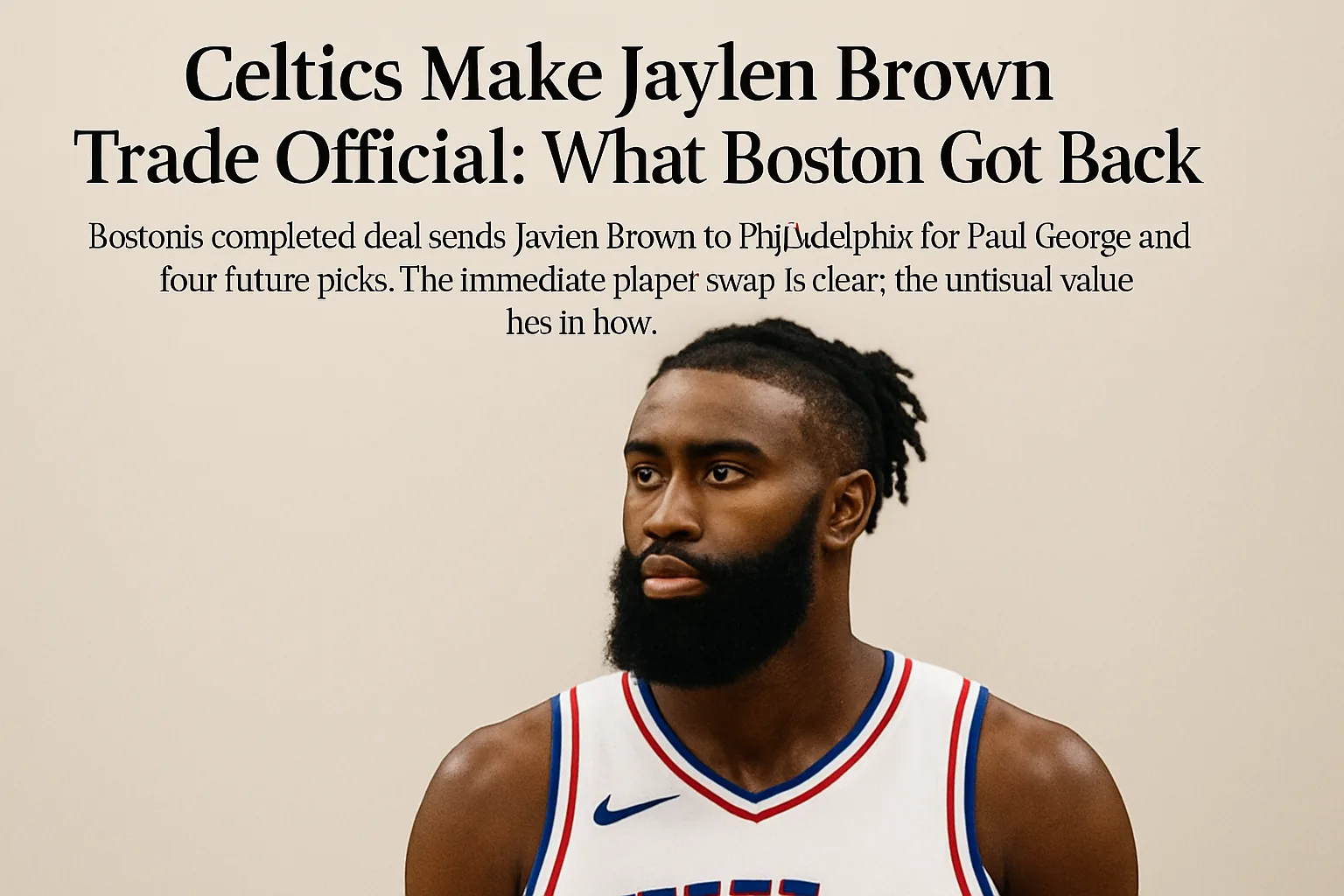
The Boston Celtics have formally completed their trade of Jaylen Brown to the Philadelphia 76ers, receiving Paul George, two first-round picks and two second-round picks in return. The transaction became official on July 6 after the league moratorium lifted.
Boston’s announcement presents the deal as both a major player exchange and a draft-capital transaction. George arrives with a résumé the Celtics highlighted: nine All-Star selections and six All-NBA selections. Brown leaves after 10 seasons in Boston, where he became one of the defining players of the club’s recent era.
President of Basketball Operations Brad Stevens paid a notably personal tribute to Brown in the team release, saying his legacy as a Celtic is “forever etched in stone.” That matters because it puts the trade in its proper frame: this is not routine roster churn. It is a move involving a player whose place in the franchise’s recent identity is already secure.
The return is more complicated than four picks
The headline version of the deal is straightforward: Boston gets George, a 2028 first-round pick, Philadelphia’s unprotected 2031 first-round pick, and two second-round selections.
The important wrinkle is the 2028 first. It originates with the Los Angeles Clippers, but it does not simply transfer as a standard first-round selection. If that Clippers pick lands in the top 16, Boston instead receives the unprotected right to swap the first-round pick it already holds in 2028—the worse of Boston’s and San Antonio’s—with the better of the Clippers’ pick or, if Philadelphia’s own 2028 pick falls outside the top eight, Philadelphia’s pick.
That is a dense condition, but the practical point is simple: Boston has gained a path to improve its 2028 draft position even if the Clippers selection does not convey cleanly. The team is not merely waiting on one lottery outcome; it has an alternative mechanism tied to several teams’ positions.
A concrete way to read the 2028 protection
Imagine the Clippers finish poorly enough that their 2028 first-round pick falls inside the top 16. In that case, Boston would not receive that pick outright. Instead, it could exchange its currently held 2028 selection for the better eligible pick from the Clippers or Philadelphia, subject to Philadelphia’s top-eight condition. The asset changes form, but it can still give Boston a way to move up the board.
This is why protected-pick language deserves more attention than it usually gets in trade coverage. “Two firsts” can mean very different things. An unprotected 2031 Philadelphia pick gives Boston a direct claim on a future draft slot. The 2028 asset is more conditional, but it creates optionality across a set of possible standings outcomes.
George changes the on-court conversation; the picks extend the timeline
Stevens described George as one of the NBA’s best two-way wings of the past decade and as a player who can fit easily into any group. That is the immediate basketball case embedded in the Celtics’ announcement: Boston receives an accomplished wing rather than a package made up solely of future assets.
The draft compensation serves a different purpose. It gives the Celtics future choices—assets that can be kept, traded later, or used to offset the uncertainty that inevitably comes with roster changes. The source material does not spell out Boston’s longer-term plan, and it would be premature to assign one. But the structure of the return is clear: the Celtics acquired a proven player while adding multiple points of future leverage.
The second-round picks are also more interesting than their labels suggest. Boston will receive the most favorable 2028 second-round pick among Golden State, Milwaukee and Oklahoma City, plus the most favorable 2030 second-round pick among Phoenix, Portland and Washington. Those are not centerpiece assets in the way a first-rounder can be, yet “most favorable” provisions give Boston the best available position from each listed group.
Why the announcement matters now
Trade reporting often makes a transaction feel complete before the league can officially process it. The Celtics’ release closes that gap. It confirms the exact asset mix and, crucially, the protections attached to the 2028 first-round component.
For Boston, the next questions are practical rather than ceremonial. How will George be incorporated into the roster? What will the team’s 2028 pick inventory look like once the protection conditions are known? And how much value will Philadelphia’s unprotected 2031 first hold by the time it becomes actionable?
None of those questions has a final answer today. The deal’s immediate result is certain, though: Brown’s decade in Boston has ended, George is now a Celtic, and Boston has added a blend of present-day pedigree and future draft flexibility rather than choosing only one of those paths.