
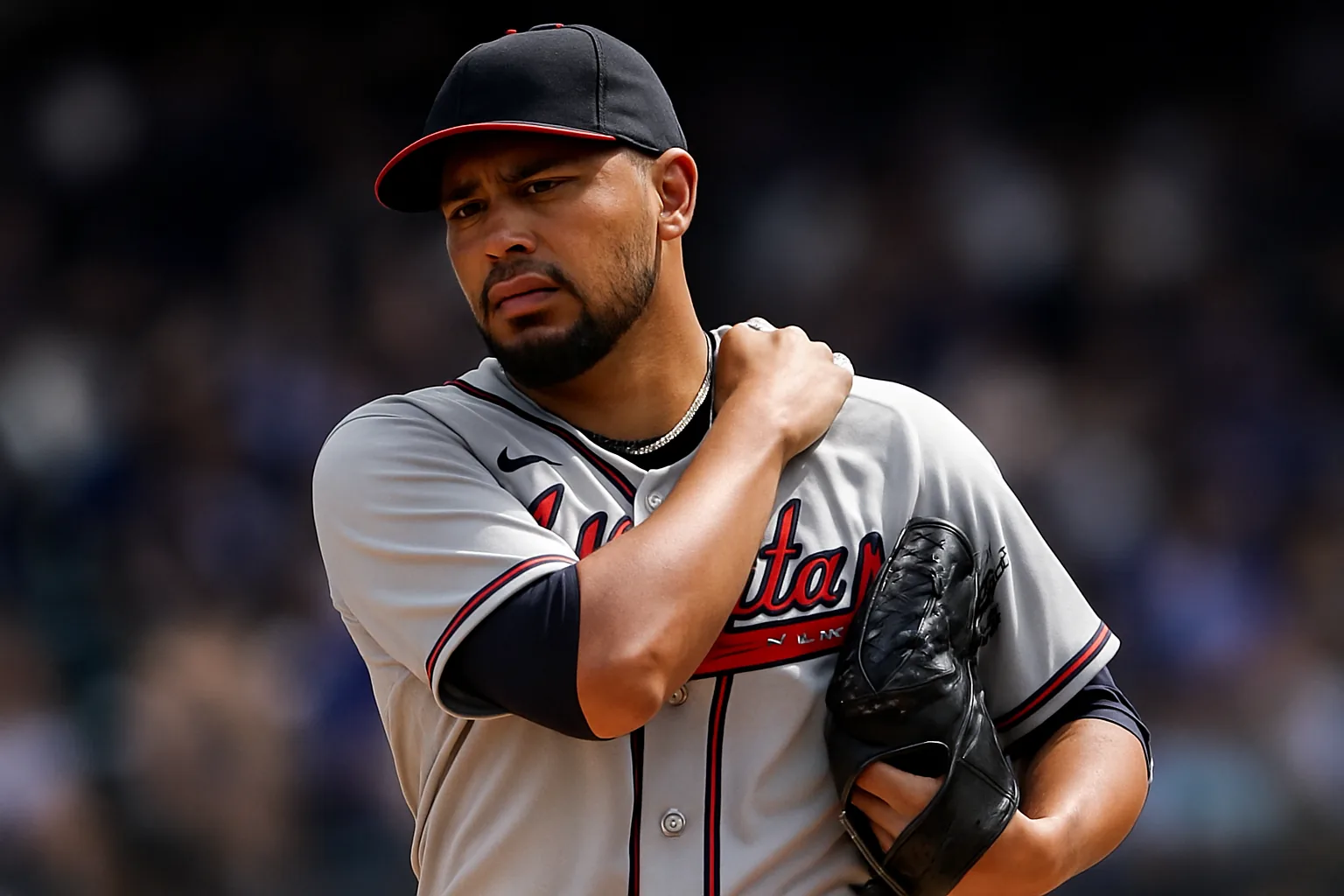
The Atlanta Braves placed left-hander Martín Pérez on the 15-day injured list Monday with a left forearm contusion, two days into a roster shuffle that says as much about Atlanta’s pitching depth as it does about one unlucky line drive.
Pérez was struck by a Juan Soto line drive during Sunday’s 10-9 loss to the New York Mets and exited the game. Braves manager Walt Weiss said afterward that X-rays were negative, a meaningful detail because forearm injuries can quickly raise larger concerns for pitchers. In this case, the listed injury is a contusion, but the Braves will still have to cover his innings at a difficult point in the season.
The move came with another notable pitching decision: Atlanta designated veteran right-hander Carlos Carrasco for assignment after he allowed five runs on five hits in two innings Sunday. The Braves recalled right-hander JR Ritchie from Triple-A Gwinnett and called up right-hander Owen Murphy, who has pitched this season for Gwinnett and Double-A Columbus. Murphy would be making his major league debut if he appears in a game.
What Atlanta Is Losing With Pérez Out
Pérez has been one of the Braves’ steadier arms this season. He is 6-6 with a 3.54 ERA across 18 games, including 14 starts. On Sunday, before leaving after the line drive, he allowed six hits and five runs, four earned, over 4 1/3 innings.
That outing was not one of his cleaner starts, but his season line matters more than one afternoon. A 3.54 ERA from a pitcher who can work as a regular starter gives a club some predictability. When that pitcher goes on the injured list, even for what may be a short stay, the cost is not just the missing player. It is the way the next few games have to be stitched together.
That is why the timing matters. Atlanta is in the middle of a series against the Mets, with the bullpen already having had to absorb extra work after Pérez exited early and Carrasco struggled. A 15-day IL placement can sound manageable, but it still creates at least a couple of rotation turns that must be covered, depending on schedule and off days.
Carrasco’s DFA Narrows the Margin
Carrasco’s designation for assignment is the sharper roster signal. The Braves did not simply add coverage for Pérez; they moved on from a veteran option after a rough appearance. Carrasco’s two innings on Sunday, with five runs allowed on five hits, left Atlanta needing both immediate innings and a better answer for the next turn through the pitching plan.
For a contending team, this is the uncomfortable middle ground of roster management. A club can tolerate a one-game pitching mess if the next day’s structure is intact. But when a starter goes to the IL and a veteran depth arm is removed from the roster at the same time, the organization has to lean more heavily on younger pitchers, recent call-ups, and Triple-A traffic.
Ritchie is already familiar to Atlanta this season. He is 1-2 with a 4.53 ERA in nine games, including seven starts, for the Braves. He had been optioned to Gwinnett on Sunday after throwing three scoreless innings to earn his first save in Saturday night’s 14-3 win over New York, then was quickly recalled as the roster changed again.
That kind of back-and-forth is common in a long season, but it is rarely ideal. It means a pitcher’s role can change quickly: starter, bulk innings option, emergency cover, then back to the majors almost immediately.
The Murphy Call-Up Is the Swing Piece
Owen Murphy is the most interesting part of the move because he brings upside and uncertainty in the same transaction. The Braves called him up after he spent time with Gwinnett and Double-A Columbus this season. If used, he would be making his major league debut.
That does not automatically mean Murphy is being handed Pérez’s rotation spot. Atlanta could use him as bullpen protection, a multi-inning option, or a short-term arm while it reassesses the rotation. But his presence gives the Braves another way to get through the next few games without forcing every inning onto the same tired relievers.
A simple example shows why this matters. If a starter leaves in the fourth inning, as Pérez did Sunday, the bullpen may need to cover five or more innings. If the next day’s starter is also shortened or ineffective, the problem compounds. A pitcher such as Murphy, even if used carefully, can protect the rest of the staff by taking lower-leverage innings or covering multiple frames. That can matter as much as one flashy debut appearance.
What This Means for the Braves
The best-case version for Atlanta is straightforward: Pérez’s negative X-rays prove to be the most important fact, the contusion settles down, and he returns after the minimum absence or close to it. In that scenario, the Braves are dealing with a temporary disruption rather than a structural pitching problem.
The less comfortable version is that the injury exposes how thin the next layer of rotation depth can become during a tight stretch. Carrasco’s DFA removes one experienced pitcher from the immediate mix. Ritchie has major league innings this season but has not fully separated himself. Murphy has yet to pitch in the majors. None of that is unusual in July, but it does put more pressure on the Braves to manage innings cleanly.
- Short term: Atlanta needs enough innings from Ritchie, Murphy, or other internal options to avoid overloading the bullpen.
- Medium term: Pérez’s recovery timeline will shape whether this remains a brief roster patch or becomes a rotation-depth issue.
- Roster watch: Murphy’s possible debut could reveal whether the Braves view him as emergency coverage or a more serious immediate option.
The Braves also recalled outfielder Jose Azocar from Triple-A Gwinnett, while outfielder Eli White was placed on paternity leave. That move is separate from the pitching picture, but it adds to the sense of a roster in motion during a busy series.
Across the field, the Mets made their own smaller depth move before Monday night’s game in Atlanta, acquiring right-hander Matt Seelinger from the Detroit Tigers for cash. Seelinger, 31, had a 3.89 ERA and one save in 27 games with Triple-A Toledo this season and has not pitched in the majors.
What to Watch Next
The first thing to watch is how quickly Pérez can resume throwing without lingering discomfort. A negative X-ray rules out one type of bad news, but pitchers still need grip, extension, and confidence after taking a line drive off the forearm.
The second is how Atlanta uses Murphy. A debut in a controlled spot would suggest the Braves want to ease him in. A higher-leverage or longer appearance would say more about the urgency of the pitching situation.
The third is whether Ritchie gets a more defined role. He has already worked as a starter and just logged a three-inning save. That flexibility is useful, but the Braves may soon need something more specific: either a pitcher who can take Pérez’s next start or a multi-inning arm who keeps the bullpen functional until the rotation stabilizes.
For now, Atlanta’s news is not a season-altering injury report. It is a depth test created by a painful play, a rough veteran outing, and the calendar. How the Braves pass it will depend less on one transaction than on whether the next wave of arms can turn a messy few days into ordinary roster maintenance.