
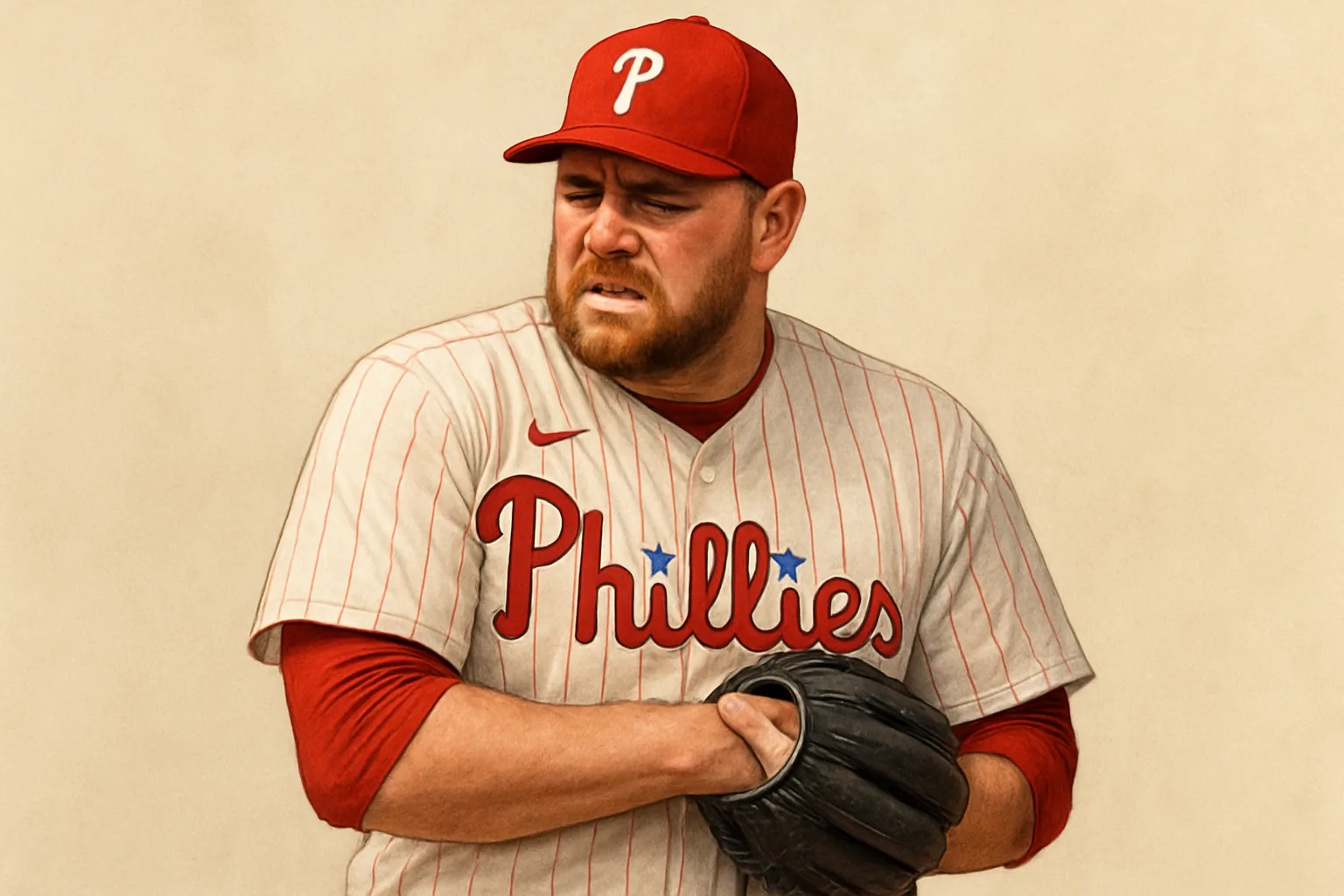
Philadelphia’s bullpen problem became more urgent on July 16 when the Phillies placed setup man Brad Keller on the 15-day injured list with a torn ulnar collateral ligament in his right elbow.
Keller is expected to miss the remainder of the 2026 season. He will seek a second opinion from elbow specialist Dr. Keith Meister before deciding whether to undergo surgery. If Tommy John surgery is required, the right-hander could also miss most or all of the 2027 season.
That uncertainty matters beyond Keller’s recovery. The Phillies signed him to a two-year, $22 million contract in December to serve as the primary setup option ahead of All-Star closer Jhoan Duran. With the Aug. 3 trade deadline approaching, Philadelphia must now replace a role, not simply cover an open roster spot.
A troubling injury sequence
Keller had already spent three weeks on the injured list with right forearm tendinitis. An MRI after the initial injury in June did not reveal a tear, according to Keller.
He returned on July 8 against Cincinnati and worked a scoreless, hitless inning, issuing one walk and recording one strikeout. Nothing during the appearance alerted him to a more serious elbow injury.
“I felt good with my outing in Cincinnati,” Keller said. “I just woke up the next day and it was really sore and it didn’t progress from there.”
The soreness persisted rather than easing after a day or two. Interim manager Don Mattingly said the team became concerned when Keller failed to recover as expected and later struggled after playing catch. Further evaluation then set the diagnosis in motion.
The timing makes the setback especially difficult. Keller’s season likely ends after 32 appearances and 31 1/3 innings, with a 4.02 ERA, according to CBS Philadelphia. The Phillies are also left with the possibility that the second year of his contract will be heavily affected by rehabilitation.
The real loss is the bridge to Duran
Duran gives Philadelphia a dependable answer in the ninth inning. The challenge is reaching him with a lead intact.
Entering the second half, Duran owned a 1.38 ERA, while Orion Kerkering had a 2.43 ERA. Beyond those two, the Phillies had been mixing relievers according to availability and matchup. Keller was supposed to make that sequence more predictable by handling many of the highest-pressure outs immediately before Duran.
Jonathan Bowlan helped stabilize the group during Keller’s first absence, posting a 0.82 ERA across his previous 24 appearances. Mattingly indicated that Kerkering and Bowlan could move into more prominent late-inning assignments.
That solves only the first part of the problem. Moving two effective pitchers later in games leaves their previous innings to less-established options. Seth Johnson, recalled from Triple-A Lehigh Valley when Keller went on the injured list, had a 7.15 ERA in 11 major-league appearances despite much better results in Triple-A.
A concrete game scenario illustrates the pressure. If a starter exits after six innings with a one-run lead, Philadelphia can assign the seventh and eighth to Bowlan and Kerkering before using Duran in the ninth. But if the starter leaves in the fifth—or either reliever is unavailable after working the previous night—the Phillies need someone else to record several consequential outs. Keller’s absence makes those ordinary schedule problems harder to manage.
Philadelphia cannot rely on role changes alone
The bullpen’s left-handed options have also been uneven. José Alvarado carried a 6.82 ERA at the time of Keller’s injury, Tanner Banks was on the injured list with a forearm strain, and Kyle Backhus had been optioned to Triple-A.
There is some reason to believe Alvarado could improve. MLB.com reported that his expected ERA was 3.71, considerably lower than his actual mark. Expected ERA accounts for factors such as strikeouts, walks and quality of contact, suggesting his performance had not been as poor as the runs column alone indicated.
That is useful evidence, but it is not the same as dependable late-inning production. A contender cannot plan its postseason bullpen around every struggling pitcher returning to form simultaneously.
Philadelphia’s internal choices now amount to three overlapping bets:
- that Kerkering and Bowlan can absorb more high-leverage work;
- that Alvarado can turn encouraging underlying numbers into better results;
- and that less-established relievers can handle the middle innings created by those promotions.
One of those bets paying off would help. Depending on all three would leave little margin for another injury or a short start.
The trade target needs to fit October, not just August
The Phillies were already considering bullpen help before Keller’s diagnosis. His injury changes the type of addition they should prioritize.
A depth reliever capable of covering low-pressure innings would make the roster longer, but would not directly replace Keller. Philadelphia now has a stronger need for someone comfortable facing the heart of an opposing lineup in the seventh or eighth inning—a pitcher who can reduce the number of nights when Kerkering, Bowlan and Duran all must be available.
That distinction matters in the postseason, when off days allow managers to lean heavily on their best arms but nearly every relief appearance carries leverage. Adding another credible late-inning option would give Mattingly more freedom to respond to matchups rather than assigning innings by necessity.
The Phillies were tied with Milwaukee for MLB’s best record since Mattingly took over on April 28, going 45-24 through the first half. Keller’s injury does not erase that progress, and it does not weaken the rotation or lineup. It does expose the narrowest part of a roster built to contend now.
What comes next
Keller’s second opinion will determine whether surgery is necessary and provide a clearer outline for 2027. For the current season, however, the Phillies already have their answer: they must proceed without the reliever hired to protect leads before Duran.
The next two weeks will reveal whether Philadelphia treats the loss as a reason to reshuffle its existing bullpen or as a mandate to acquire another high-leverage arm. Given the team’s position and the cascading effect of Keller’s absence, standing still would be the riskier choice.