
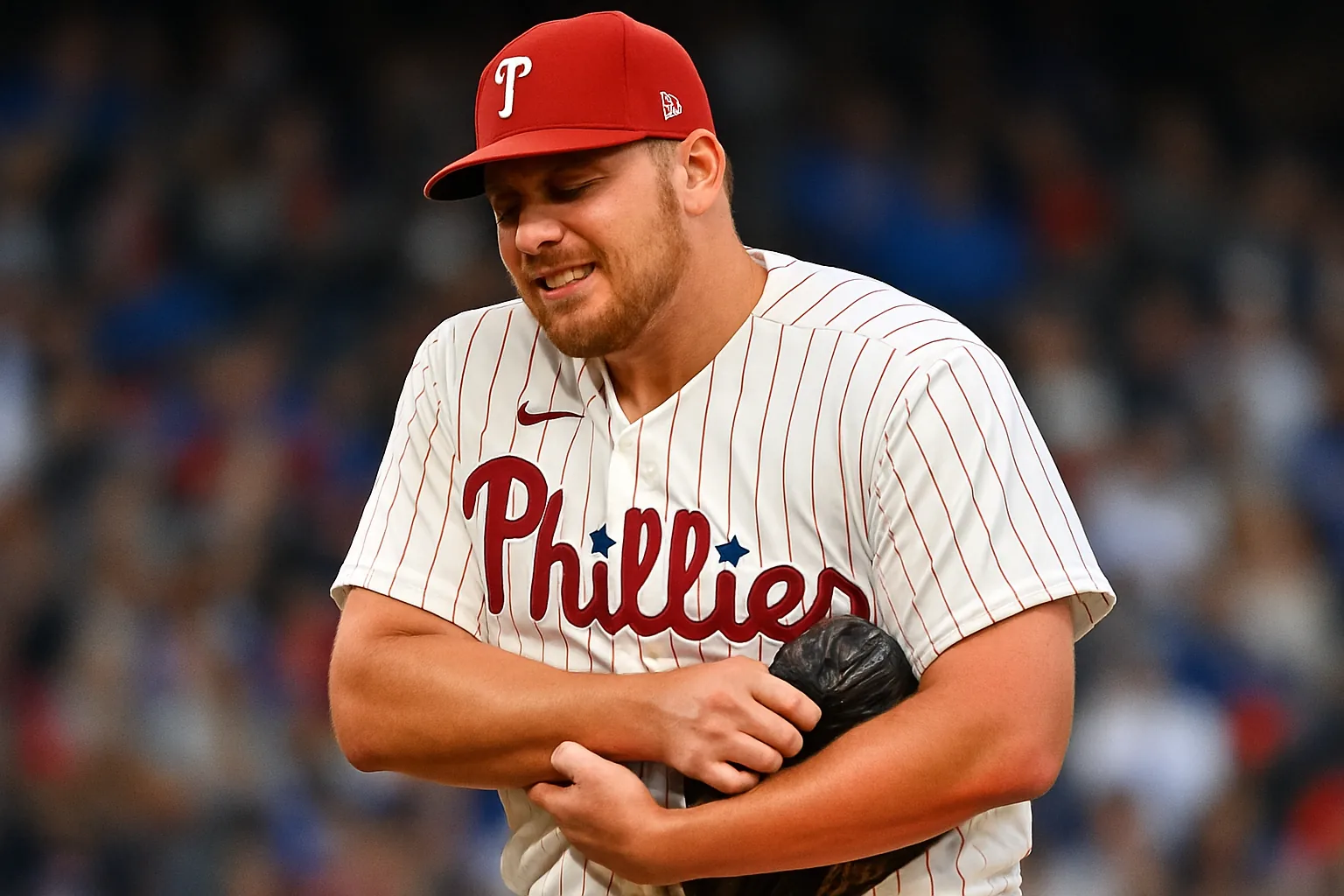
The Philadelphia Phillies entered the second half needing bullpen help. Brad Keller’s torn right ulnar collateral ligament has turned that need into a deadline priority.
Keller was placed on the 15-day injured list on July 16 and is expected to miss the remainder of the 2026 season, according to MLB.com’s report. He is seeking a second opinion from Dr. Keith Meister before deciding whether to have surgery.
The distinction matters beyond this season. If Keller requires Tommy John surgery, interim manager Don Mattingly said the right-hander could also miss most or all of 2027. Keller signed a two-year, $22 million contract with Philadelphia during the offseason.
Right-hander Seth Johnson was recalled from Triple-A Lehigh Valley in the corresponding roster move. That gives the Phillies another available pitcher. It does not provide a direct replacement for the setup role Keller was expected to hold.
A missing link in the late-inning chain
Philadelphia has a dependable endpoint in All-Star closer Jhoan Duran, who had a 1.38 ERA when Keller’s injury was announced. Orion Kerkering, with a 2.43 ERA, has also given the club a reliable late-game option.
The uncertainty lies between the starting rotation and those final outs. Keller was supposed to help protect leads before the ball reached Duran. Without him, Mattingly can move Kerkering and the improving Jonathan Bowlan into more demanding situations, but every promotion creates an opening one inning earlier.
A simple game scenario illustrates the problem. If a Phillies starter leaves after six innings with a one-run lead, the intended sequence could have been Keller against a dangerous part of the opposing order, Kerkering in the eighth and Duran in the ninth. Move Bowlan into Keller’s assignment and Philadelphia still needs someone to handle the seventh-inning outs Bowlan might otherwise have covered. One injury can therefore weaken several matchups, not just one bullpen slot.
Bowlan has earned the opportunity to move up. He carried a 0.82 ERA over his previous 24 appearances, including one earned run allowed in 13 outings after Keller first went on the IL with right forearm tendinitis on June 14. Tim Mayza had also improved, giving the Phillies useful internal responses rather than a completely empty depth chart.
But those responses depend on pitchers sustaining recent gains while taking on harder assignments. That is different from adding another established late-inning arm and allowing Mattingly to choose matchups instead of filling vacancies.
The left-handed relief problem remains
Keller’s absence is especially damaging because Philadelphia was already receiving uneven results from its left-handers. At the time of the announcement, José Alvarado had a 6.82 ERA, Tanner Banks had a 7.14 ERA and was sidelined by a left forearm strain, and Kyle Backhus had been optioned to Triple-A with a 5.87 ERA.
Alvarado is the most important variable. His 3.71 expected ERA was far better than his actual mark, suggesting that the amount and quality of contact he allowed did not fully match the runs charged against him. That provides a reasonable case for improvement, but it is not a guarantee that the bullpen can simply wait for his results to normalize.
The Phillies now face two separate questions: whether Alvarado can recover his usual late-inning value, and who can absorb Keller’s right-handed setup work. Improvement from Alvarado would ease the pressure. It would not restore the depth lost with Keller.
Why the trade calculation has changed
Philadelphia was already considering one or two relievers before the injury. The club reached the All-Star break at 54-43, two games behind in the NL East, after going 45-24 from Mattingly’s appointment on April 28 through the break. This is a contender deciding how aggressively to reinforce a vulnerable area, not a marginal team debating whether to buy.
The timing leaves the front office until the Aug. 3 trade deadline, but Keller’s diagnosis narrows the type of addition that would be most useful. An innings-eating middle reliever could improve depth. A pitcher trusted against the middle of a postseason lineup would address the more consequential problem.
That distinction affects what Philadelphia may have to surrender. An MLB.com deadline assessment described the farm system as lacking depth and identified Double-A pitcher Gage Wood as a potentially significant trade chip. Wood and Alex McFarland are also internal bullpen possibilities, but neither was considered ready to step directly into the major-league opening.
The Phillies therefore have several imperfect paths:
- Promote current relievers into higher-leverage roles and accept less certainty in the middle innings.
- Rely on Alvarado’s underlying performance translating into better results.
- Trade prospect capital for a reliever capable of working near the back of the bullpen.
These choices are not mutually exclusive. Philadelphia can give Bowlan a larger role and still pursue outside help. The practical question is whether the front office seeks insurance or a pitcher who can materially change the late-game order.
What Keller’s injury means beyond 2026
Keller’s contract made him more than a short-term rental. Philadelphia signed him after a strong 2025 season with the Chicago Cubs, when he recorded a 2.07 ERA and 0.96 WHIP in 68 appearances. His move to relief had also brought a career-best average fastball velocity of 97.2 mph, according to MLB.com’s account of the signing.
If surgery removes him from most or all of 2027, a deadline acquisition with control beyond this season could carry additional value. That is an inference rather than a stated Phillies plan, and the medical decision has not yet been made. Still, the second opinion will influence whether the club is replacing Keller for one pennant race or planning around a much longer absence.
For now, the immediate test is operational. Kerkering and Bowlan move closer to the highest-leverage innings. Johnson, Max Lazar, Chase Shugart and others may be asked for bigger outs earlier in games. Alvarado’s performance becomes even more important.
The Phillies still have enough bullpen talent to protect leads. What Keller’s injury removes is margin: the ability to survive an off night, a poor matchup or another injury without pushing several pitchers beyond their established roles. That is the gap Philadelphia must decide how much it is willing to pay to close.