
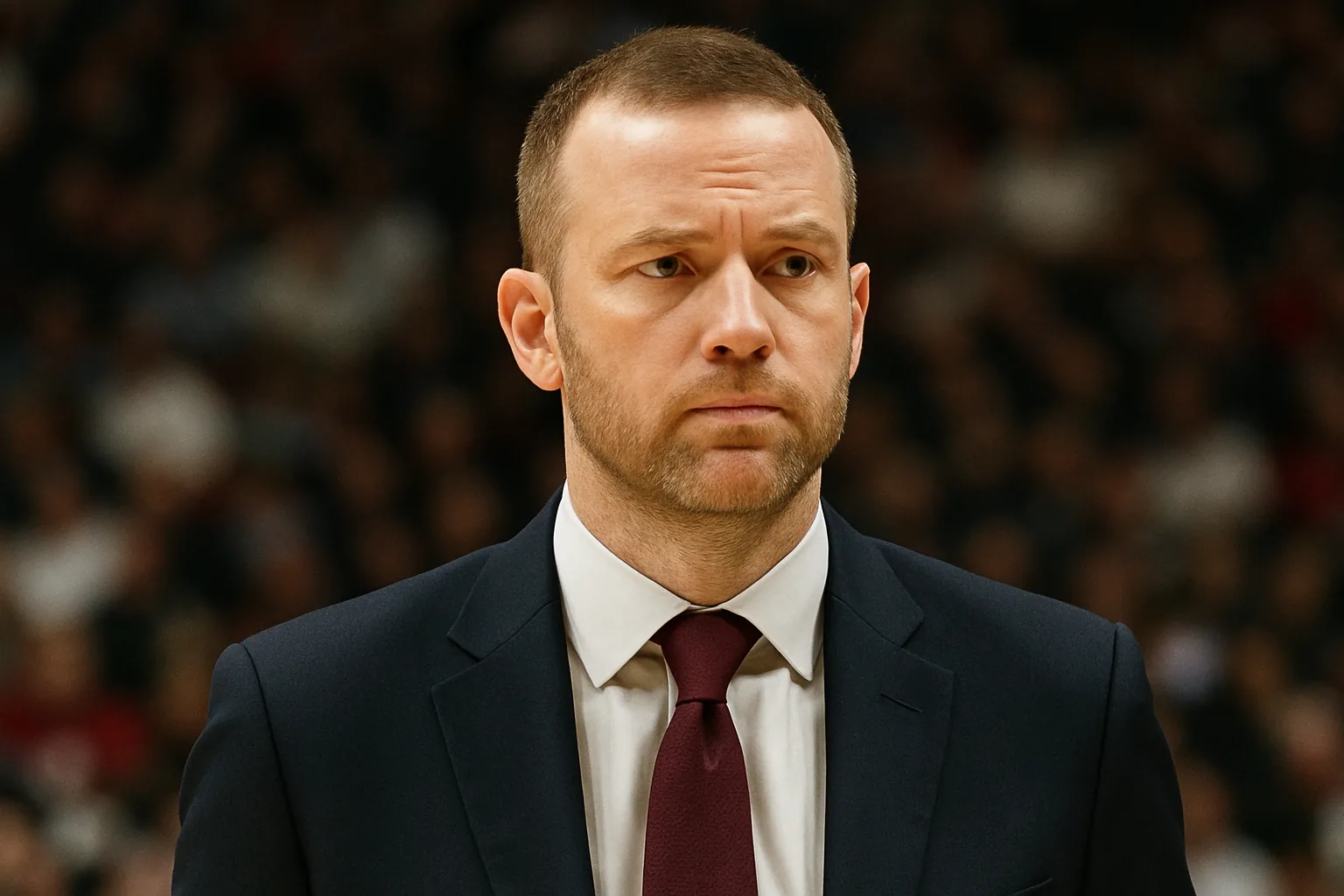
Boston College introduced Luke Murray as its new men’s basketball head coach while he was still helping UConn prepare for the Final Four. That awkward overlap was the story as much as the hire itself.
Murray called the past few weeks “absolutely wild,” and the description fits. He was toggling between two jobs before officially starting one of them: assistant coach on a national title contender, and incoming head coach of a program that has not reached the NCAA Tournament since 2009. Boston College did not hide the urgency. It held the introductory press conference now, not after UConn’s season ended, because its own reset needed to begin immediately.
Why the timing matters
Coaching changes often come with logistical mess. This one comes with a very public split screen.
On one side is UConn, still playing for the biggest prize in the sport. On the other is Boston College, trying to stop a decline that its own framing makes hard to ignore: Murray is the Eagles’ fourth coach since 2010, and he inherits a program that has been outside the NCAA Tournament for 17 years.
That is why this is not just a human-interest story about a coach juggling a busy week. It is also a window into how much pressure sits on programs stuck in the middle. BC cannot afford a slow, ceremonial transition. Even before Murray is fully on campus, the program has to start acting like it has a leader.
That matters in practical ways. A head coach hire is not only about next season’s opening night. It is about roster decisions, relationships inside the building, recruiting conversations, staff planning, and the basic signal a school sends about whether it is serious. Waiting neatly until the Final Four dust settled may have looked cleaner. It also would have cost time.
What BC is really buying
Boston College is not hiring Murray on head coaching experience. This is his first top job. It is hiring the combination of his background, his relationships, and his daily exposure to a program that is still operating at championship level.
That distinction is important. Schools in BC’s position rarely get a perfect candidate. They are usually choosing between proven winners from smaller settings, recognizable assistants from major programs, or riskier bets with local or institutional ties. Murray fits the second category, and the logic is easy to see even if the outcome is far from guaranteed.
He arrives from an environment where the standard is unusually high. That does not automatically travel. Plenty of assistants leave elite programs and discover that building one is different from serving in one. But for BC, the appeal is obvious: if you have been stuck for years, borrowing habits from a program still playing in April can look a lot better than preserving the habits you already have.
The school’s move also suggests it wanted someone who could give the job a jolt of credibility fast. Murray’s connection to Dan Hurley and UConn’s current run gives BC a cleaner story to tell recruits, donors, and fans than another generic rebuild pitch.
The balancing act is the first test
Murray’s introductory remarks made the transition sound less strategic than chaotic. He described trying to remember when conversations with BC athletic director Blake James first became real. He recalled reviewing a contract on an iPad in Washington while preparing for UConn’s Sweet 16 game against Michigan State. He described Hurley eventually asking what was going on, and Murray answering, in effect, that he was taking the job.
That sequence is revealing because it shows what the next few weeks are likely to look like. Murray is not walking into a quiet spring. He is arriving with one foot still planted in a Final Four preparation cycle. Even if everyone involved is handling the overlap professionally, the new coach’s attention is being divided at the exact moment BC needs momentum.
There is a charitable way to read that tension, and a skeptical one.
The charitable reading is that BC hired someone worth waiting a few extra days for, and that a coach helping a team chase a title is not a bad symbol to import. The skeptical reading is that a fragile program needs full-time problem solving, not a part-time handoff. Both readings can be true at once.
A concrete example of what changes now
Consider a simple spring scenario. A current player or transfer target wants to know what Boston College basketball will actually look like next year: style, staff, role, priorities, and whether the new coach has enough backing to turn promises into reality.
Before the hire is public and formal, those conversations are fuzzy. After the press conference, they become more credible, even if Murray is still finishing UConn’s season. BC can say, clearly, who is in charge. That does not solve the larger roster or talent problem by itself, but it changes the tone from uncertainty to direction. For a program that has drifted, that is not a minor administrative detail. It is part of the rebuild.
What success would actually look like
Boston College’s problem is not that it has lacked announcements or optimism. The program has lacked traction.
Murray will be judged less by the novelty of this hiring timeline than by whether he can establish signs of competence quickly. That starts with basics: assembling a staff, making the program look organized, and giving BC a basketball identity that feels sharper than “trying to catch up.” It also means turning the school’s ACC platform into something more than background branding. A league badge is not enough when the results have been this thin for this long.
The source material around Murray’s introduction points to the central challenge. BC is not coming off a one-year dip. It is trying to reverse a decline that has lasted long enough to feel structural. That changes the burden on a first-time head coach. He does not just need to coach well. He needs to make the program feel alive again.
What to watch next
The first headlines around Murray were always going to focus on the unusual optics: the son of Bill Murray, introduced at BC while still on UConn’s bench, describing a month that blurred together. That angle will fade quickly.
The real story starts after UConn’s season ends.
- How fast Murray can shift from symbolic hire to daily operator.
- Whether BC gives him enough support to make the transition more than cosmetic.
- Whether his UConn background produces a real upgrade in talent acquisition and program discipline.
- Whether the school’s urgency now is matched by patience once the hard parts begin.
Boston College did not hire Luke Murray just to win a news cycle. It hired him because the program has spent too many years looking stuck. Announcing him in the middle of a Final Four run underscored both sides of the gamble: BC wants a piece of that competitive edge, and it wants it now. The harder part is still ahead. Borrowing championship aura is easy. Building a program that deserves its own is not.