
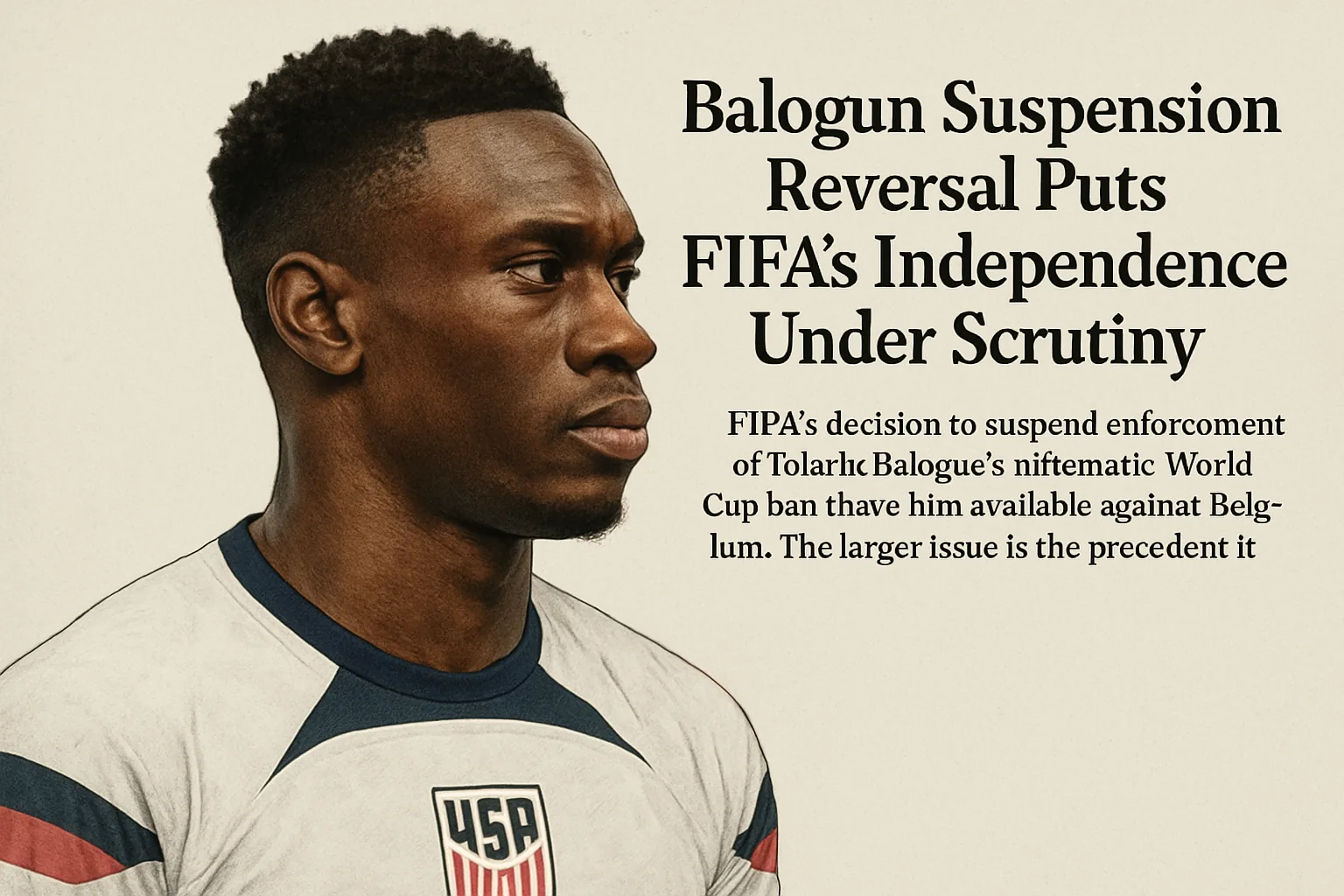
Folarin Balogun was cleared to face Belgium after FIFA suspended enforcement of the automatic one-match ban triggered by his July 1 red card. Belgium’s attempt to challenge that decision was then ruled inadmissible by FIFA’s appeals committee, leaving the United States forward available for the Round of 16.
The immediate sporting consequence was simple: the U.S. could use a key forward in a knockout match. The harder question is why a disciplinary decision normally treated as automatic was paused after President Donald Trump called FIFA president Gianni Infantino and asked for a review.
FIFA has pointed to Article 27 of its disciplinary code, which allows a judicial body to fully or partially suspend implementation of a disciplinary measure. The organization has not publicly laid out requirements for using that provision in cases like Balogun’s, or explained in detail how it applied the rule here. Balogun could still face the one-match suspension, along with any future sanction, if he commits a similar offense within the next year.
A routine red card became a governance test
Balogun’s dismissal came after he stepped on an opponent’s ankle during the United States’ 2-0 win over Bosnia-Herzegovina. A red card ordinarily brings a one-game ban, which is why his absence against Belgium initially appeared settled.
Trump later said he did not initially understand what a red card meant or the effect it would have. Once he learned Balogun would miss the knockout match, he called Infantino and asked FIFA to reconsider what he described as a horrible call. He argued that slow-motion replay made the incident appear worse than it was.
FIFA president Gianni Infantino said the disciplinary committee acted independently, based on the applicable rules and the specific facts. UEFA disagreed sharply, calling the decision “unprecedented, incomprehensible and unjustifiable.” That disagreement is the real story. It is not only about whether the original red card was too harsh; it is about whether the process can persuade opponents and supporters that the same rules apply to every team.
Why Belgium’s failed appeal does not settle the controversy
FIFA rejected Belgium’s challenge on procedural grounds, saying the Belgian soccer body was not a party to the proceedings and therefore lacked standing to appeal. That explains why Belgium could not overturn the ruling through that route. It does not answer the wider concern about the ruling itself.
In a tournament setting, timing makes that distinction especially important. The decision arrived shortly before a knockout match against the team directly affected by it. Belgium may have had no formal right to appeal under FIFA’s process, but it still had to prepare for a different U.S. lineup than the one an automatic suspension had suggested.
There is also a fairness problem that goes beyond Belgium. Disciplinary rules work partly because players, coaches and opponents can plan around them. If an automatic sanction can be delayed through a rarely used provision without a detailed public rationale, every later controversial case invites a comparison: why was this player granted relief and another one not?
The practical cost of an unclear exception
Consider a hypothetical late group-stage match. A team’s leading scorer receives a red card for a challenge that produces a standard one-game ban. Its next fixture is a knockout game, and the federation believes the call was excessive. If the Balogun decision is now viewed as an available model, that federation has a strong incentive to seek the same suspension of enforcement.
That is not necessarily wrong. Rules can need flexibility, particularly when an appeal or review raises a genuine question. But flexibility needs visible guardrails: what evidence is required, who may ask for relief, how quickly a decision is made, and why the case meets the standard. Without them, an exception looks less like a legal remedy and more like access.
FIFA’s reliance on Article 27 suggests it has the authority to act. The unanswered issue is consistency. The more consequential the match and the more prominent the outside intervention, the higher the burden on the governing body to show that the outcome came from an ordinary, repeatable process.
What to watch after the Belgium match
The result of the U.S.-Belgium match will not resolve the institutional debate. A U.S. win would intensify discussion because Balogun’s availability could become part of the match’s story; a loss would not erase the concerns over how the decision was reached.
The next meaningful test is whether FIFA provides a fuller explanation of the disciplinary committee’s reasoning and clarifies how Article 27 will be used in future World Cup cases. UEFA’s unusually forceful response means other federations will be watching closely, especially when suspensions affect major matches.
For fans, the lesson is not that every controversial red card should be immune from review. It is that review has to be legible. Football accepts arguments over refereeing every week. What damages confidence is uncertainty over whether the route to relief is governed by the rulebook, the facts of a case, or the influence surrounding it.