
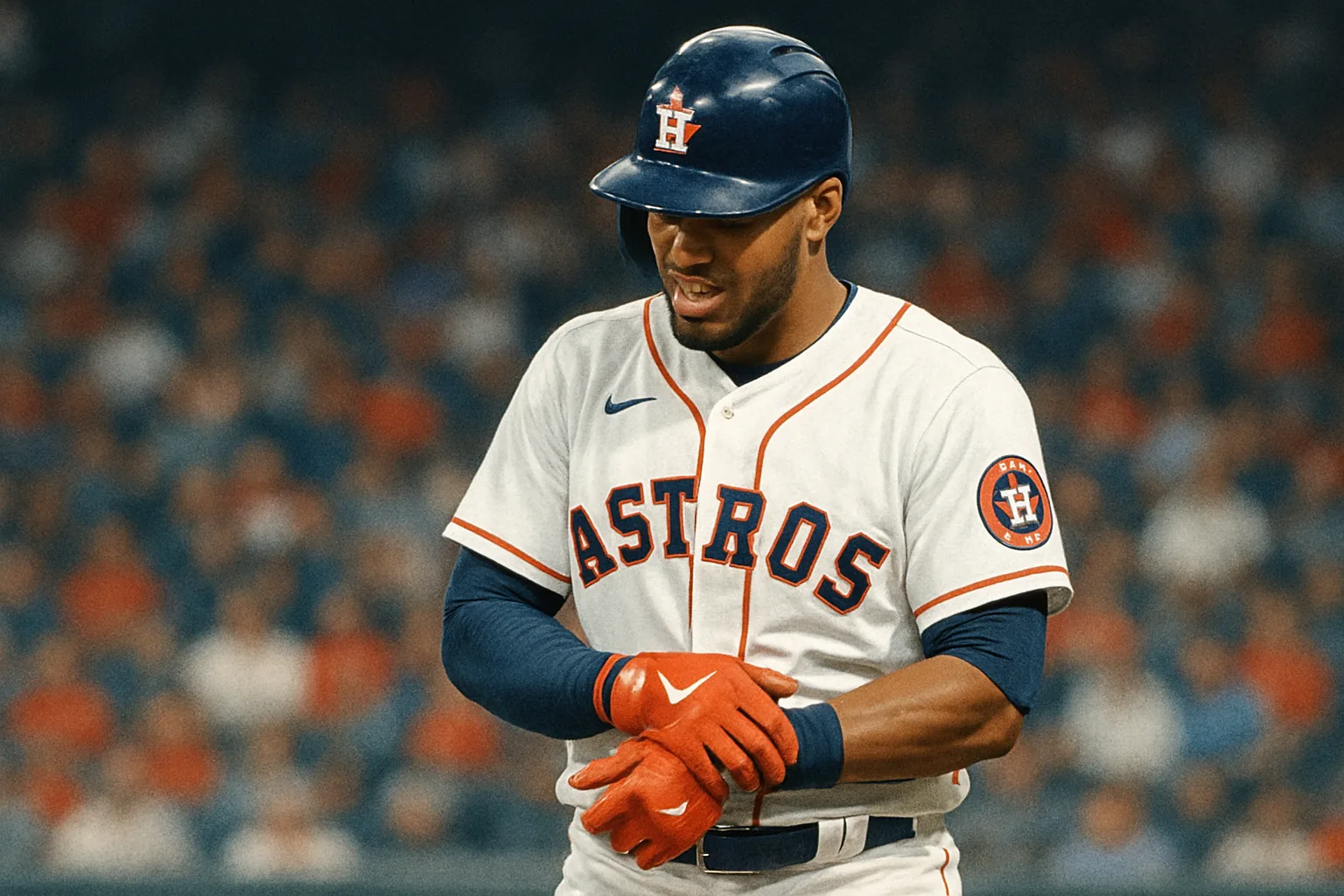
The Astros added two more names to the injured list on April 13, and the timing matters as much as the names themselves.
Shortstop Jeremy Peña went to the 10-day IL with a Grade 1 right hamstring strain. Rookie right-hander Tatsuya Imai was placed on the 15-day IL with right arm fatigue. Houston also optioned Jayden Murray to Triple-A Sugar Land and recalled J.P. France, Colton Gordon and Shay Whitcomb.
On paper, that can read like a standard early-season shuffle. In reality, it looks more like a stress test for a club that has already been dealing with a rough start and a growing list of unavailable pitchers.
Why these two injuries land differently
Peña’s absence matters because he is not just another position player missing a week or two. He is an everyday shortstop on a team that depends on defensive reliability up the middle, and he was already trying to play through an uneven start shaped by earlier health problems.
According to the source, Peña had been removed in the fourth inning of the April 11 game in Seattle after feeling tightness behind his right knee. By Monday, the diagnosis had become clearer: a Grade 1 right hamstring strain. Peña said he did not have a return timeline and wanted to make sure he was fully healthy before coming back.
That last part is important. A minor hamstring strain can sound manageable, but it affects exactly the kind of movements a shortstop cannot fake: first-step reactions, planting, changing direction, charging slow rollers, and accelerating out of the batter’s box. If Houston rushes him, the risk is not just reduced performance. It is turning a short absence into a recurring problem.
Imai’s injury carries a different kind of concern. Right arm fatigue is not the same as a firm structural diagnosis, but it is not a label teams use casually either. The source notes that he flew back to Houston after struggling with command in Friday’s loss and that manager Joe Espada said more testing was underway Monday.
That sequence tells its own story. When a pitcher records only one out, cannot consistently throw strikes, and then leaves for evaluation, the issue is no longer simply about one bad outing. It becomes a question of health, availability, and how much the club can count on that rotation spot in the near term.
The bigger problem is overlap
Teams can absorb a single infield injury. They can also survive one more pitcher going down if the rest of the staff is stable. What becomes difficult is the overlap.
Houston is dealing with exactly that. The source explicitly ties these latest IL moves to a wider rash of injuries that has sidelined multiple pitchers and helped fuel the team’s poor start. That means the Astros are not solving isolated problems. They are trying to cover several pressure points at once.
Peña’s situation affects lineup continuity and defense. Imai’s affects innings, bullpen workload, and the club’s ability to avoid emergency pitching decisions by the middle of a series. Those are different parts of the roster, but they feed into the same outcome: less room for error every night.
That is why the recalls matter. J.P. France and Colton Gordon give Houston innings options. Shay Whitcomb gives the club another position-player solution while Peña is out. None of those moves is surprising. The challenge is cumulative: when replacement decisions become routine in mid-April, the roster starts operating in contingency mode instead of normal mode.
Peña’s start had already been disrupted
One detail from the source helps explain why this is more than a short-term inconvenience. Peña was coming off a career season, but his spring had already been interrupted when he fractured the ring finger on his right hand during an exhibition game while playing for the Dominican Republic’s World Baseball Classic team in March.
He still made the Astros’ Opening Day roster, though he was not playing every day during the season’s first week. That matters because it means he was already trying to establish rhythm after a delayed buildup. Now, before he could fully settle in, another physical issue has pushed him off the field again.
For an everyday player, especially one expected to anchor premium defense, that stop-start pattern can drag on performance even after the player is technically available again. The Astros do not just need Peña active. They need the version of Peña that can handle the position without compromise.
A concrete example of what this changes
Consider what a normal series can look like when both problems show up at once.
If a fill-in shortstop gives Houston slightly less range for a week, that may cost only a play here or there. But if the starter on the mound also exits early, those extra balls in play start landing in front of a defense that is already adjusting, and the bullpen has to cover more outs. What might have been a quiet one-run win can turn into a game where the Astros need six or seven relievers just to get through the night.
That is the practical effect of overlapping injuries. The loss is not limited to the individual player. It spreads through the roster’s daily workload.
Why Houston’s depth is under a real test
Early-season standings can invite overreaction, but April is still where teams either protect themselves from turbulence or let it compound. Houston now has less margin to treat this as a temporary annoyance.
The recalled players will get a real chance to matter, not just fill out a box score. France and Gordon may be asked to stabilize innings at a moment when the club cannot keep asking the bullpen to absorb extra stress. Whitcomb may have to help patch together infield coverage while Peña recovers.
That is where the Astros’ organizational depth gets judged honestly. Depth is often praised in abstract terms before the season. This is the stage where it has to produce actual outs, actual innings, and competent defense over the next stretch of games.
It is also where the front office and coaching staff have to be disciplined. The temptation with a player like Peña is obvious. If he starts feeling better quickly, a contender can talk itself into an accelerated return. The better decision, based on the source’s own tone and Peña’s comments, is likely the conservative one. A healthy everyday shortstop in May is worth more than a rushed return in April.
What to watch next
The immediate question on Peña is straightforward: how quickly does a Grade 1 hamstring strain calm down, and does Houston give him enough time to return without obvious restrictions? His own comments suggest the player is thinking in those terms already.
Imai’s case is more unsettled. Arm fatigue can resolve with rest, but the fact that additional testing was underway makes the next update more significant than Monday’s transaction itself. Houston needs clarity on whether this is a brief interruption or the start of a longer absence.
There is also a broader team question beneath both injuries. Can the Astros keep the rough start from hardening into a real standings problem while they patch the roster?
That is the central issue now. The injuries to Peña and Imai are notable on their own, but the real story is the pressure they put on everything around them: defensive stability, rotation planning, bullpen usage, and the club’s ability to regain momentum before the season’s first month gets away from it.
In April, teams rarely lose a season in one week. They can, however, make the next six weeks much harder than they needed to be. Houston’s latest IL moves push the Astros closer to that line.