
ARC Prize Foundation released ARC-AGI-3 on March 25, 2026, and the headline number is hard to ignore: humans solve the benchmark, while frontier AI systems are still below 1% on the official release leaderboard. The benchmark is designed to test something current AI products are often assumed to be getting good at: entering a new environment, figuring out what matters, and adapting without being told what to do.
That matters because ARC-AGI-3 is not another static question set. It is the first fully interactive benchmark in the ARC-AGI series, built from hundreds of handcrafted turn-based environments and thousands of game-style levels. There are no instructions, no rules, and no stated objective. An agent has to explore, infer the mechanics, work out the win condition, and then use what it learns as levels get harder.
The accompanying technical report, dated March 24, 2026, says all ARC-AGI-3 environments included in the benchmark were verified to be 100% solvable by humans with no task-specific training. By contrast, the semi-private release leaderboard reports 0.37% for Google Gemini 3.1 Pro Preview, 0.26% for OpenAI GPT 5.4 (High), 0.25% for Anthropic Opus 4.6 (Max), and 0.00% for xAI Grok-4.20 (Beta 0309 Reasoning).
What ARC-AGI-3 is actually testing
The interesting part is not just that models score poorly. It is why they score poorly.
ARC-AGI-3 shifts the series away from static pattern inference and toward what the paper calls four components of agentic intelligence: exploration, modeling, goal-setting, and planning with execution. In plain English, the benchmark is asking whether a system can enter a situation it has not been prepared for and become effective before brute force becomes the strategy.
That last point is important because the benchmark does not reward eventually stumbling into an answer after enough moves. It uses an efficiency metric called Relative Human Action Efficiency, or RHAE, which compares an AI system’s action count with a human baseline. A system that needs far more moves than a person gets sharply penalized. That makes ARC-AGI-3 a test of adaptation efficiency, not just raw completion.
For readers trying to place this in the current AI cycle, that is a useful correction. A lot of modern AI discussion treats “agentic” as a broad label for systems that can chain tools, follow instructions, and operate in well-scaffolded workflows. ARC-AGI-3 is asking for something narrower and harsher: can the system discover the task itself?
A concrete example of the gap
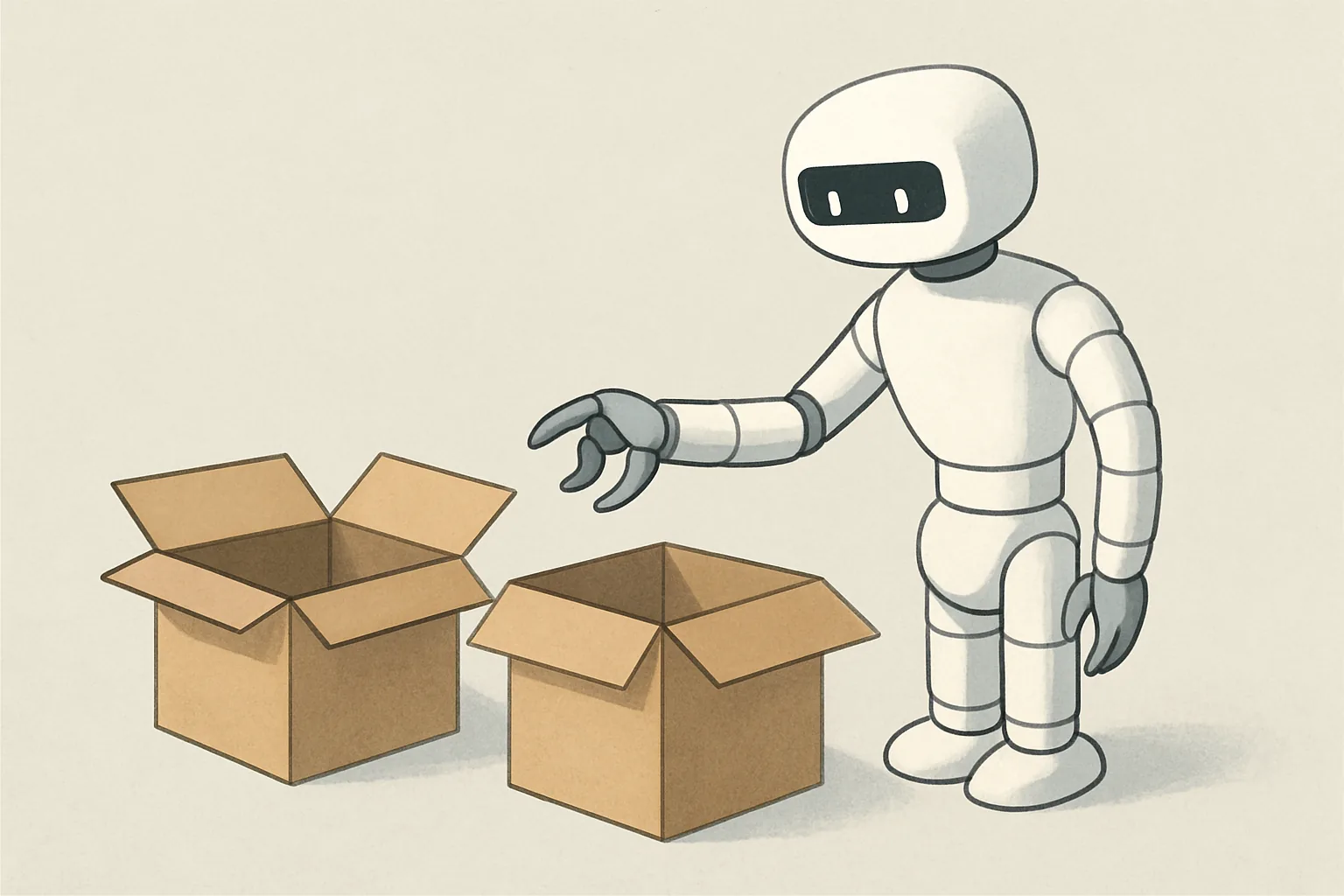
Imagine an AI agent dropped into one of these environments. It sees a small turn-based game state, but there is no prompt explaining the controls, no goal text, and no hint about what counts as success. One action might move a token. Another might reset the state. A third might reveal that an obstacle is actually a tool. A human player can often probe a few moves, form a hypothesis, revise it, and then play efficiently. ARC-AGI-3 is measuring whether an AI system can do that same kind of first-contact learning instead of burning moves until something works.
That is a stricter and more useful question than “can the model solve a benchmark if we wrap it in the right harness?” It gets closer to the difference between a system that looks capable inside a polished product and one that can genuinely orient itself in unfamiliar territory.
Why this lands at an awkward moment for AI claims
ARC Prize argues that earlier ARC benchmarks tracked real shifts in the field, including the rise of stronger reasoning models and coding agents. Whether one accepts all of the foundation’s framing or not, ARC-AGI-3 arrives at a moment when the industry increasingly talks as if broad autonomous agents are nearly here.
The release pushes against that tone. It suggests current frontier systems may be much better at operating inside known formats than at independently discovering structure in new ones. That does not make today’s models weak in general. It does make many sweeping claims about general reasoning and open-ended autonomy look premature.
The paper is explicit on another point that deserves attention: benchmark design now has to worry not just about memorization of test items, but about higher-level shortcutting. ARC-AGI-3 responds by making the public set more of a demonstration interface and shifting real evaluation weight to semi-private and fully private environments that are intentionally out-of-distribution from the public examples. That is a direct answer to a problem that affects far more than ARC. Once benchmarks become famous, they start leaking into the training and prompting ecosystem around them.
Why operators and builders should care
For founders, product teams, and anyone deploying AI systems, the release is useful because it separates two kinds of progress that are often blended together.
- One kind is economically valuable harness progress: better scaffolding, better tool use, tighter loops, more domain-specific setup.
- The other is progress toward systems that can adapt to truly unfamiliar problems with human-like efficiency.
ARC-AGI-3 does not dismiss the first category. In fact, the paper says harness innovation still matters and will likely advance task automation. But it also refuses to treat that as the same thing as general intelligence. That distinction is easy to blur in marketing copy and investor conversations. It is harder to blur when the benchmark withholds the instructions entirely.
There is also a safety angle here. If one goal of evaluation is to understand what frontier systems can and cannot do, benchmarks that isolate exploration and goal inference are valuable precisely because they test behavior outside polished demo conditions. A model that performs impressively when the world is pre-labeled may still be fragile when the task has to be discovered from scratch.
What to watch next
ARC Prize 2026 opens alongside the benchmark with more than $2 million in prizes across ARC-AGI-3, ARC-AGI-2, and a paper prize. The competition structure matters almost as much as the leaderboard snapshot. All leading participants are expected to open source their methods, and the competition rules say internet access is not available during Kaggle evaluation, which rules out a simple “just call a frontier API” path.
The immediate question is not whether leaderboard numbers move. They will. The more useful question is how they move.
If scores rise mainly through benchmark-specific harness engineering, that will still have product relevance, but it will not settle the harder question ARC-AGI-3 is trying to ask. If scores rise on the guarded private sets in ways that reflect better first-contact adaptation rather than exploitation of public patterns, then the benchmark will have identified a real capability change.
For now, ARC-AGI-3 offers a clean datapoint in a noisy conversation. Models that can write, code, and reason impressively under guidance are not yet showing much evidence of efficient self-directed learning in unfamiliar interactive environments. That is a narrower claim than “AI can’t reason,” and a more useful one. It tells readers exactly where one of the remaining gaps still is.