
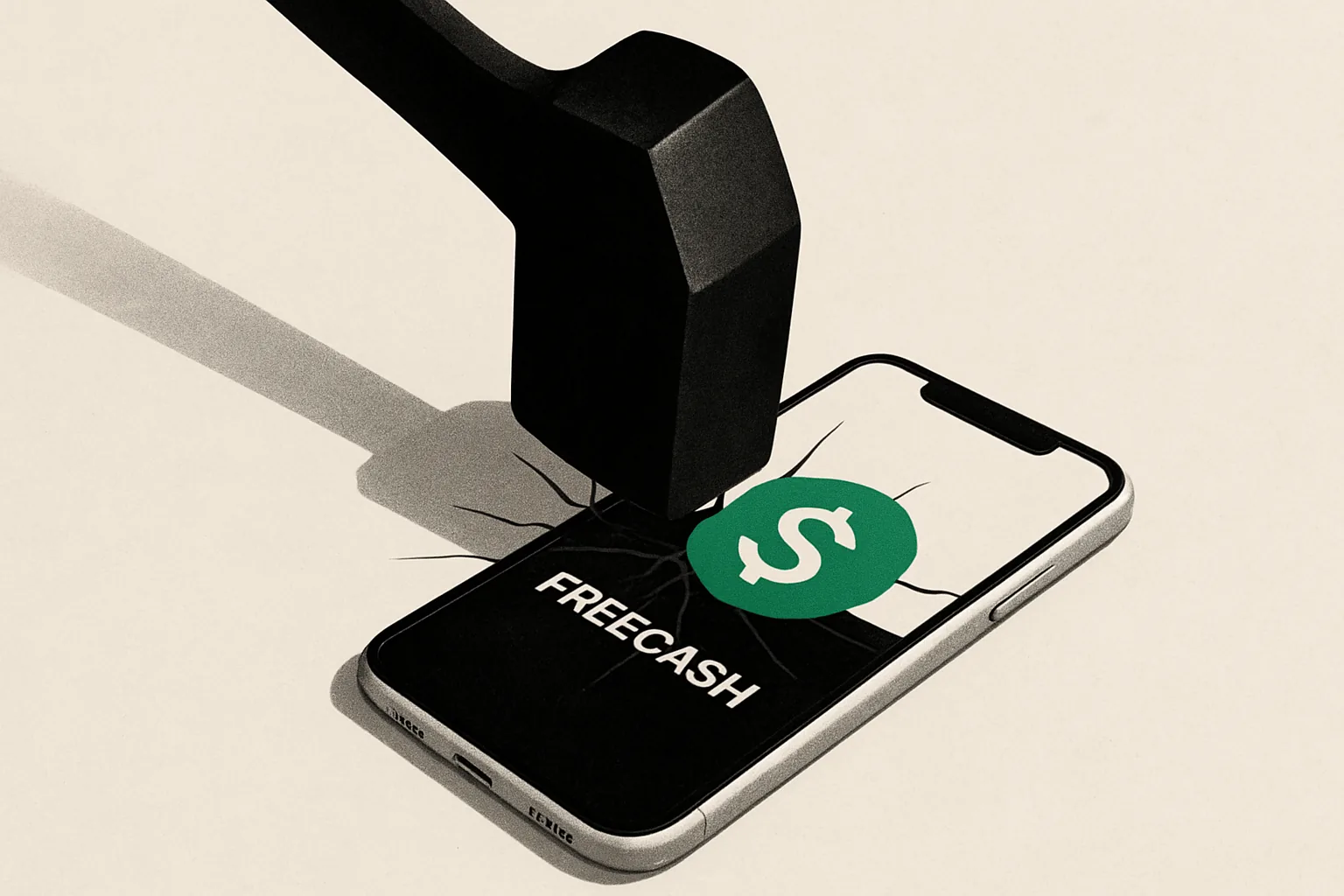
Apple has removed Freecash from the App Store after months of viral growth driven by TikTok ads that pitched the app as an easy way to make money. The takedown matters for more than one app. It exposes a familiar but still effective formula in the mobile economy: promise simple cash, bury the real tradeoff, grow fast on creator platforms, and sort out the fallout only after millions of people have already seen the pitch.
According to TechCrunch, Freecash had climbed as high as No. 2 on the U.S. App Store. Its ads suggested users could earn money by scrolling TikTok. But the reporting says that was not the real model. Freecash paid users to play mobile games, while also collecting extensive sensitive data, citing a Malwarebytes report that described the app as functioning like a data broker matching game developers with users likely to install and spend money inside games.
That distinction matters. There is a big difference between “get paid for scrolling” and “enter a funnel where your activity and profile help drive game installs and spending.” One sounds like frictionless side income. The other sounds like the kind of exchange most users would want explained in plain language before opting in.
What Apple’s removal actually signals
Apple’s decision did not arrive in a vacuum. Earlier reporting from Wired had found that Freecash used deceptive marketing techniques and nudged users to spend money in games. TikTok later pulled some of the app’s ads for violating its rules on financial misrepresentation. Freecash said at the time that the problematic ads came from third-party affiliates rather than the company itself.
Even if that defense is taken at face value, it does not solve the larger problem. Affiliate-driven growth is still part of the growth machine. If an app rises through marketing that creates the wrong expectation, users do not experience that distinction as a fine point of ad attribution. They just feel misled.
TechCrunch reported that Apple removed the app after being contacted for comment. Tom’s Guide separately confirmed the takedown and noted that the app remained on Google Play at the time of its report. That timing is revealing. App-store enforcement often looks decisive from the outside, but in practice it can be delayed, uneven, and reactive. A product can sit near the top of the charts for months before the platform response catches up.
The real issue was not just the ads
The ad angle is the easiest part of this story to understand, because deceptive “easy money” marketing is visible and intuitive. The deeper issue is the data model attached to that promise.
The Malwarebytes report cited by TechCrunch says Freecash may collect information related to race, religion, sex life, sexual orientation, health, and biometrics. That is not a normal detail to brush past in a rewards-app story. If those allegations are accurate, then the real product was never just “earn rewards.” The product was also user profiling, audience qualification, and downstream monetization for mobile game marketers.
That changes how the story should be read. This is not only about whether one app exaggerated how users make money. It is also about how easily a cheerful, low-friction consumer app can become a gateway to data extraction that many users would neither expect nor fully understand.
A concrete example of why this matters
Imagine a user who sees a short TikTok video promising extra cash from a phone app. They install Freecash expecting something close to passive income. Instead, they are pushed toward mobile games, encouraged to complete offers, and nudged into spending behavior that benefits developers and marketers. At the same time, the app may be gathering far more personal information than that user would associate with a simple rewards tool.
That gap between expectation and reality is where a lot of modern app growth lives. Not in a direct lie so obvious that everyone stops immediately, but in a blurry zone where the headline promise is cleaner and simpler than the actual transaction.
Freecash is useful as an example because each piece reinforces the others: viral short-form promotion, affiliate amplification, rewards mechanics, mobile game monetization, and sensitive data collection. None of those elements is new on its own. Combined, they create an unusually efficient engine for growth.
Why creator-platform hype keeps producing these cases
TikTok is excellent at compressing a complicated pitch into a compelling claim. That is good for distribution and bad for nuance. An app that would sound questionable in a longer explanation can sound irresistible in a 15-second clip, especially when the promise is framed around money rather than entertainment or utility.
That does not make creator platforms uniquely responsible. It does show how well their incentives line up with certain kinds of marketing. Affiliates and advertisers are rewarded for attention and conversion, not for giving users a careful account of how a product works. By the time moderators, journalists, or app stores intervene, the campaign may already have done its job.
Freecash also shows the limits of relying on app-store rankings as a trust signal. Many users still assume that a top-charting iPhone app has already cleared meaningful scrutiny. In reality, chart success can reflect paid promotion and viral spread faster than it reflects substantive review. The ranking tells you what is being downloaded, not what deserves confidence.
What businesses and users should watch next
The obvious question is whether this becomes a one-off embarrassment or a broader warning shot. The answer depends on whether platforms start treating deceptive “earn money” marketing and aggressive data collection as linked problems instead of separate moderation buckets.
There are a few things worth watching next:
- Whether Google’s enforcement fully matches Apple’s after the initial gap in availability.
- Whether TikTok and similar platforms tighten review of affiliate-driven financial claims in app advertising.
- Whether app stores put more scrutiny on rewards apps whose real business model depends on user targeting and gaming spend.
- Whether publishers and cybersecurity firms keep surfacing similar cases before they become chart-toppers.
For operators and marketers, there is a practical lesson here too. Growth channels that depend on blurred claims can scale quickly, but they also create platform risk that lands suddenly and publicly. If a product’s best-performing ad cannot accurately describe how the product works, that is not a creative optimization problem. It is usually a business-model warning.
For regular users, the takeaway is less dramatic but more useful: when an app promises easy money, the question is not just “is this real?” It is “what am I actually being asked to trade?” In Freecash’s case, the answer appears to have involved far more than a few minutes of attention.
Apple’s removal of the app does not undo the months of growth that came before it. What it does do is puncture the illusion that top-ranked, heavily advertised apps are automatically straightforward products. Sometimes the pitch is the product. The rest of the experience is how the money gets made.