
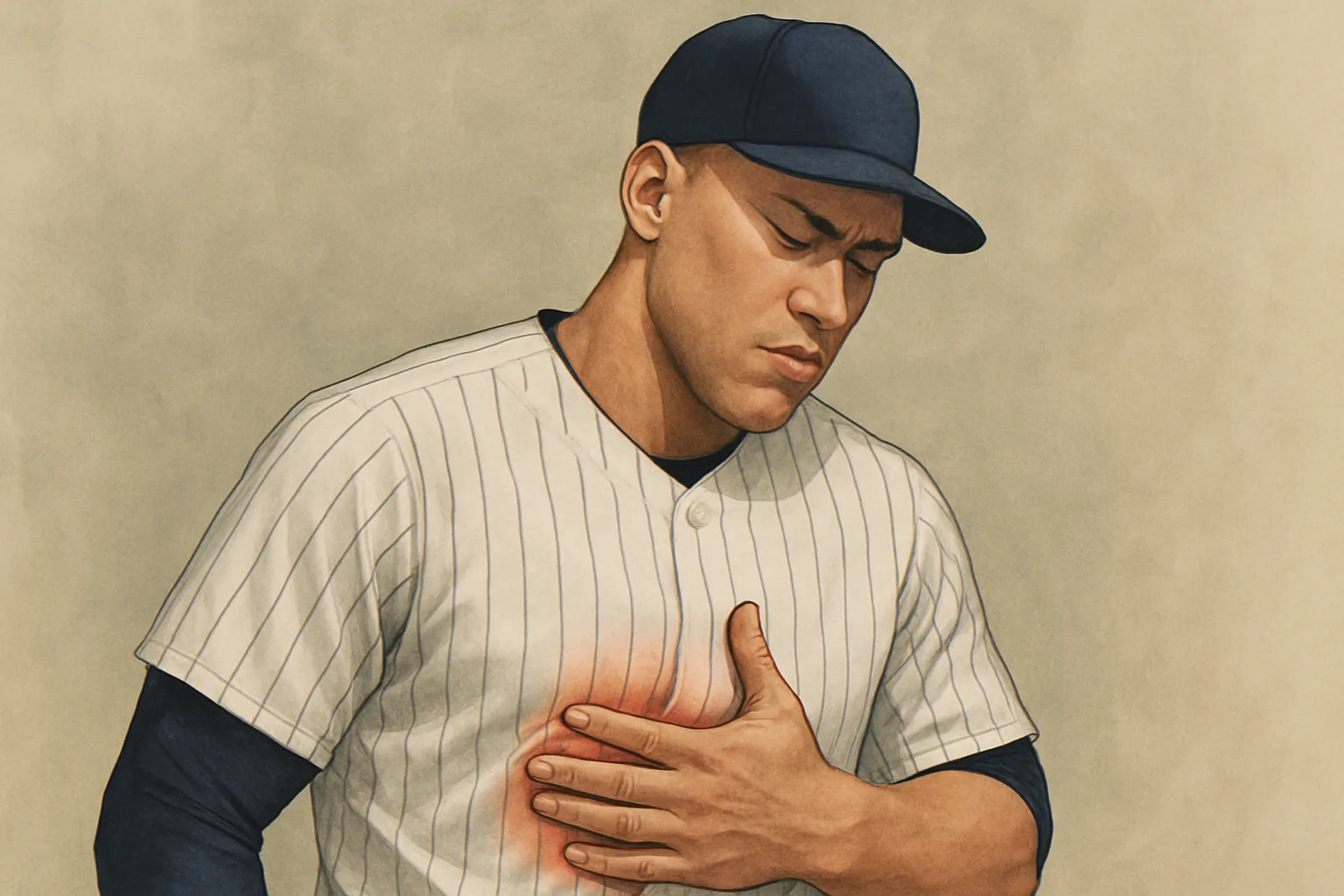
The Yankees placed Aaron Judge on the 10-day injured list Friday, June 5, with a stress fracture of the first rib on his right side, retroactive to June 2. The club recalled outfielder Spencer Jones from Triple-A Scranton/Wilkes-Barre, giving one of its top prospects a clearer path to regular playing time while Judge rests.
The most important detail is the timetable. Judge is not being ruled out for the season, which matters for a Yankees club with October expectations, but the team said he will be reimaged in four to six weeks to determine how much healing has occurred and what comes next. That means this is not a standard short injured-list stay. It is a wait-and-see injury with a built-in pause before baseball activity can be mapped out.
According to <a href='https://www.mlb.com/news/aaron-judge-diagnosed-with-stress-fracture-in-ribs'>MLB.com, the Yankees feared a worse outcome before the diagnosis. Judge underwent several days of testing, including an MRI, X-rays and a CT scan, and manager Aaron Boone said swelling made it harder to identify the source of the issue. The diagnosis came after a consultation with Dr. Gregory Pearl in Dallas, whose practice specializes in thoracic outlet syndrome management in high-performance athletes.
What the Yankees lose while Judge rests
Judge is not simply a power bat removed from the lineup. He is the hitter around whom opposing pitching plans are built. When he is present, the Yankees can force decisions: pitch to him, work around him, or risk creating traffic for the hitters behind him. When he is absent, that stress shifts away from the opponent and back onto New York.
The Yankees got a small preview during their three-game series against Cleveland. Without Judge, they leaned into a lower-margin style, including a small-ball rally in a 2-1 win. That kind of game can be encouraging for one night because it shows adaptability. Over several weeks, it asks a harder question: can a team constructed around elite middle-of-the-order damage consistently manufacture enough offense when the biggest source of that damage is unavailable?
That is the practical problem behind the injury news. The Yankees do not need one player to become Judge. They need several smaller gains to add up: more competitive at-bats from the bottom half of the order, steadier run prevention, better situational execution, and enough production from replacement outfielders to avoid turning right field into a soft spot.
Why Spencer Jones matters now
Jones, ranked by MLB Pipeline as the Yankees’ No. 6 prospect, is the most interesting part of the roster response. His recall is not just injury coverage. With Judge on the injured list and both Jasson Domínguez and Giancarlo Stanton still rehabbing, Jones should have room to play rather than sit behind established names.
That distinction matters for a prospect. A brief call-up built around pinch-running, late defense and sporadic starts rarely tells a club much. An extended run in right field gives the Yankees a better look at how Jones handles major league pitching, daily preparation and the defensive responsibilities of a corner outfield spot in a high-pressure market.
A concrete version of the test might look like this: in a close game, Jones comes up with one out and a runner on second in a spot where Judge would normally alter the entire inning. The opposing pitcher does not have to treat Jones the same way. Jones may see more direct challenges in the strike zone, more breaking balls once behind, and fewer free bases created by reputation alone. If he can turn some of those at-bats into hard contact, walks or productive outs, the Yankees can survive more innings without their usual gravitational force.
That is not the same as replacing Judge’s production. It is about preventing the lineup from becoming too easy to navigate.
The defensive and roster ripple effects
Before Jones was recalled, the Yankees used José Caballero and Max Schuemann in right field during the Cleveland series. That is a useful signal. The club was not just missing a bat; it was also searching for a workable defensive arrangement while multiple outfield and designated hitter options remained unavailable.
Right field at Yankee Stadium carries its own demands, and Judge’s value there is easy to understate because his bat overwhelms the conversation. Any replacement plan has to account for routes, arm strength, positioning and how much the Yankees are willing to trade defense for offense on a given night.
Jones getting playing time can simplify that math if he proves playable defensively and gives Boone a more natural outfield option. If he struggles, the Yankees may have to keep mixing personnel, which can affect late-game substitutions and bench flexibility. In a tight division race or playoff positioning battle, those small roster frictions can become visible quickly.
What changes next
The Yankees’ next checkpoint is medical before it is tactical. Judge will rest and remain inactive, then be reimaged in four to six weeks. Only after that can the club determine whether he is healing well enough to begin the next stage. Even an optimistic reading leaves open questions about timing, ramp-up, swing progression and game readiness.
For the front office, the injury also changes the way the summer should be evaluated. If Judge’s recovery tracks well, the priority may be staying afloat and avoiding overreaction. If the lineup drags, or if the re-evaluation creates uncertainty, the Yankees may have to think more seriously about external help or a more aggressive reshuffling of playing time.
The immediate stakes are simpler:
- Jones gets a real opportunity because the Yankees need more than a temporary bench piece.
- The lineup has to diversify because one swing will not solve as many nights without Judge.
- The medical update matters more than the 10-day IL label because the true timeline begins with the four-to-six-week re-evaluation.
The best news for New York is that the injury is not currently being framed as season-ending. The harder part is that “expected back this season” still leaves a large competitive gap. Until Judge is cleared to move beyond rest, the Yankees have to play a different kind of baseball, and they have to learn quickly whether Jones can be part of that answer rather than just the corresponding roster move.